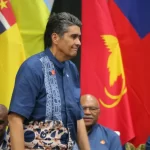

The Territorial Assembly of French Polynesia has for the first time shown a new configuration during its first administrative sitting on Friday, following a mass resignation of a group of young elected members of the ruling Tavini Huiraatira.
This follows the mass resignation of a group of 15 members of the Assembly, now headed by 25-year-old member Tematai Le Gayic.
The mass resignation de facto brings down Tavini’s majority to 22 within the Territorial Assembly (of a total of 57 MPs).
The outcome of the rift within the ruling party is that now, for the first time in its history, it’s divided into two groups.
One consists of the remaining “old guard’, headed by historic pro-independence “radical” members such as former President Oscar Temaru, 81, and his closest ally, Antony Géros (currently Speaker of the Assembly and Vice-President of the Tavini Party).
On the other side, the breakaway group of Tavini members from a younger generation, under a group now called “A Fano Tia” (Stay the course) now gathers some 15 members.
“A Fano Tia” is also reported to be close to French Polynesia’s government President Moetai Brotherson, whose father-in-law is no other than Temaru himself (Brotherson is married to Temaru’s daughter).
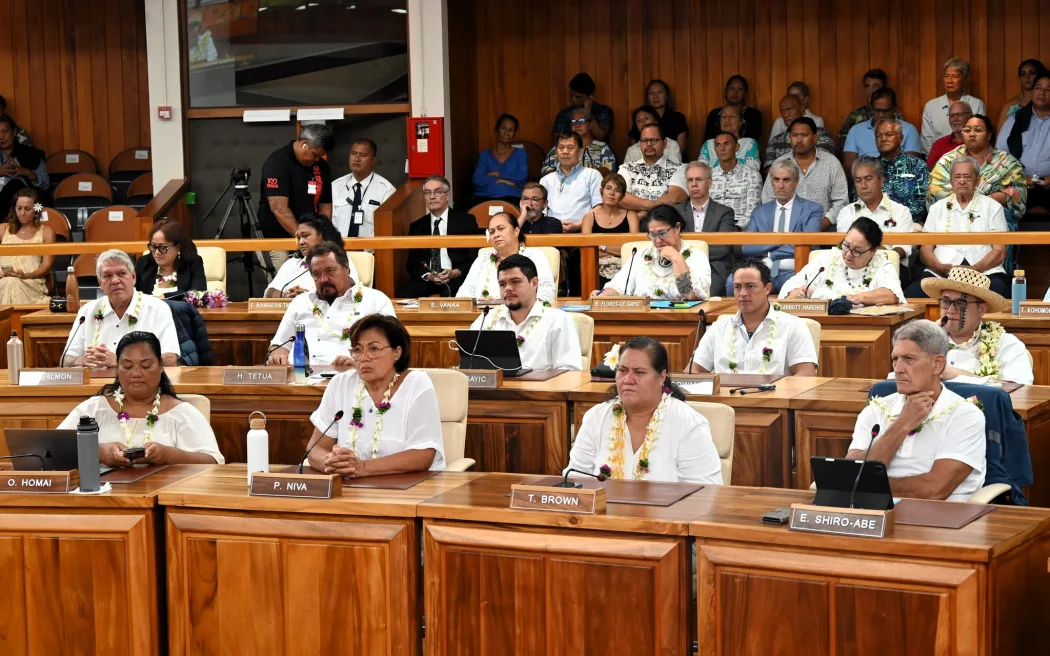
To mark their difference and differences with their former party, under which they were elected during the territorial elections (in May 2023), at this new sitting, A Fano Tia members made a point to all appear dressed in white, as opposed to Tavini’s official light blue colour.
The sitting was marked by heated debates between the two groups, while the opposition ‘pro-autonomy” (in effect supporters of French Polynesia remaining part of France under the current Autonomy Status) essentially stood as spectators.
As a preview to future debates and local Assembly’s modus operandi, until the next territorial elections, in 2028, questions have been raised as to how a more divided house could function.
There could be more open opposition during debates for future Bills, especially those which are related to points of notorious contention (such as the notion of independence).
Tavini’s hard line, defended by Temaru, favours a short-term process to access French Polynesia’s independence, including a more confrontational approach vis-à-vis France.
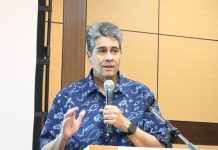
Speaking last week), Brotherson elaborated on the divergence of views regarding independence.
“Independence is not an end in itself … it’s a choice, but this choice can be neither imposed nor rushed,” Brotherson said last week at the tribune.
In earlier statements, Brotherson had favoured a more gradual process within a window “ten to fifteen” years.
More than ever, every Bill is likely to be treated on a case-by-case basis and alliances formed accordingly around the vote.
This could also involve, on the same principle, more alliances between A Fano Tia and pro-autonomy Tapura Huiraatira, as well as a handful of independent MPs.
It could involve more open opposition from the “historic” Tavini, which could oppose future Bills from Brotherson’s government.
The other components of the Assembly include 16 from the opposition pro-France (pro-autonomy) Tapura Huiraatira and 4 others not registered under any party.
The rules have changed, but no one wants to topple the government
Sometimes floated during earlier Tavini internal debates, the notion of Brotherson’s departure or resignation as President was eventually not regarded as a solution.
“Since we were elected and until 2028, there won’t be any defiance motion”, Géros publicly assured.
“We’re asking the (Brotherson) to carry the weight of his Presidency until 2028,” he told MPs.
Tapura, on its side, said it was not prepared to “contribute to government instability”.
“We’ll always be here in a constructive way”, Tapura wrote in a release posted on social networks.
It however deplored that during this session, the floor was “confiscated” by Tavini’s internal bickering.
Any motion of defiance requires the approval of at least 35 of the 57 MPs.
At the sitting last week, the allocation of chairs for the Assembly’s very influential legislative committees was also renewed.
A Fano Tia said it did not intend to bid for any of those because it did not want to be accused of being “opportunistic”.
As a result, Tavini retained the chair of key committees such as Economy, Finance and Budget, Education, Youth and Sports (which could turn crucial as French Polynesia is hosting the 2027 Pacific Games), as well as Tourism and Culture.
Opposition pro-autonomy Tapura also retains Employment and Public Service and gains one more Committee (Health and Solidarity).
Other parliamentary Committees (Institutions and international affairs, Housing, Land and sustainable development, Transports and Public Words, as well as Agriculture and Marine resources – another point of contention between the historic Tavini and A Fano Tia – were allocated to other Assembly groups.
“Unfortunately, today, (Assembly) debates were confiscated by political statements. And at the end of the day it is (French) Polynesians who will be forgotten,” French Polynesia’s representative at the French Senate Teva Rohfritsch deplored.