



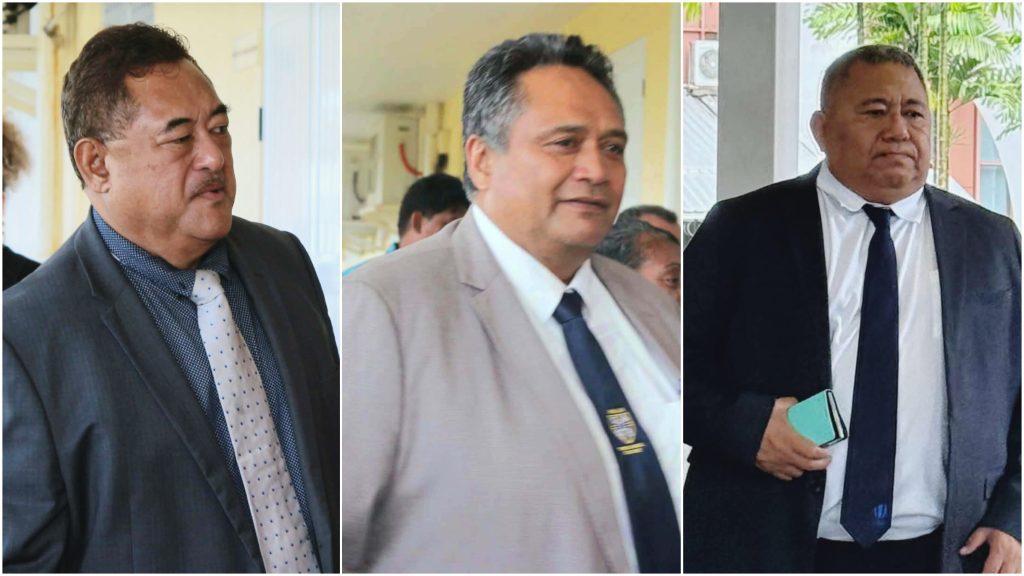
The Samoa Electoral Court has today ruled that deputy Prime Minister and Member of Parliament for Falealili I, Toelupe Maoiautele Pou Onesemo, is guilty of bribery over a claim that $150 tala (US$54) was given to a couple who could not be found to present their evidence in Court.
The decision that is expected to have significant political and legal implications for future election petitions, was handed down this morning by Chief Justice Satiu Simativa Perese and Justice Leiataualesa Daryl Clarke before a packed court room of supporters and media.
The ruling follows months of legal proceedings in which the Court went out of its way to consider evidence relating to allegations of electoral misconduct, after both parties had applied to withdraw their original petitions.
Central to the Court’s determination was its acceptance of sworn affidavits from two witnesses who, despite not being physically located during the proceedings, were deemed credible by the Court. The Court found the voters’ evidence through written affidavits was accepted, and stated that the candidate, through his lawyers, did not provide any evidence to challenge it.
In delivering its decision, the Electoral Court emphasised that the affidavits provided sufficient evidentiary weight to support the bribery finding. The absence of the witnesses did not, in the Court’s view, undermine the substance of their testimony.
The sworn affidavits did not point to Toelupe himself, but to a third party. The voter and his wife’s affidavits claimed that $150 tala (US$54) was given to them by a third party on the night before elections, to influence their vote. The Court then also ruled that the person who gave the money was acting for the candidate, holding Toelupe responsible.
“The Court is satisfied that the evidence relied up on credible and reliable.”
“The Respondent is therefore guilty of the corrupt practice of bribery.”
“Pursuant to Section 116 of the Electoral Act 2019, the Respondent’s election is declared void.”
The case also drew public attention due to a telephone recording submitted by HRPP Member of Parliament, Namulauulu Sami Leota, who recorded a conversation he had with Petitioner, Tuiloma Lance Lameko.
According to submissions presented in Court, the recording allegedly captures a conversation in which it is claimed that Tuiloma Lance was offered and received $100,000 (US$363) in exchange for withdrawing the original bribery complaint.
At the time, both Petitioner (Tuiloma) and Respondent (Toelupe) had filed to withdraw their election petitions.
Furthermore, witnesses for both parties did not turn up to Court.
Today’s ruling places significant implications in Samoa as Toelupe held the position of Deputy Prime Minister and also the Minister for Works, Transport and Infrastructure.
Member of the Falialili I constituency have raised questions about the immediate political consequences, including the loss of their elected Member of Parliament.
The decision is also expected to set an important and highly dangerous precedent regarding the acceptance of written affidavits evidence in electoral disputes, particularly in cases where witnesses are unavailable.
“What is to stop people from signing affidavits to ruin a winning candidate’s political career, when they don’t have to turn up to Court? And yet, their affidavits will be taken as evidence in Court?”
Decisions of the Electoral Court are not subject to appeal. However, it anticipated that the decision may be subject to appeal, with legal avenues still open to challenge the ruling based on the use of affidavits.