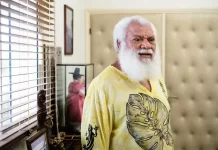
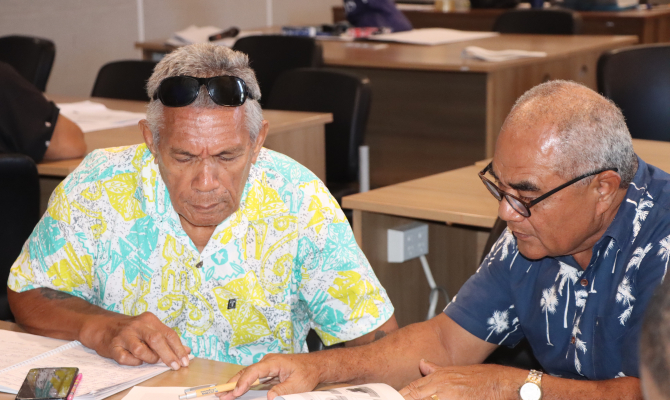
When people lose their language, they lose what makes them unique. For Satalaka Petaia, an elder from Nui Island in Tuvalu, it is a scenario he fears for his community, and it is something he is extremely concerned about.
“Our Nuian language is dying, our younger generation now mostly speak Tuvaluan, and other languages,” he lamented. “I’m sad about this. Our Nuian language is our culture, our identity. If we lose it, we’ll no longer be known as Nuians. We are unique, our languages makes us unique but this is disappearing.”
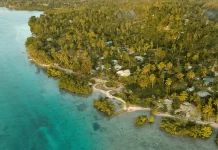
Nui is an atoll island of Tuvalu. With a population of 600, the island is a four-hour boat ride from Funafuti. The Nui culture has Micronesian influences from Kiribati and it is the only island in Tuvalu that speaks Kiribati language.
Petaia believes language is a gift from our forebears, a gift that should be treasured and passed from generation to generation.
“Over the years, I’ve witnessed the slow decline of our language,” he said. “I’m not sure if climate change is directly responsible but I know the impacts of it are related to what is happening.
“From a cultural standpoint, we need to reinvent ourselves, revive our customs, languages and traditions. As part of this project, my hope is that we can divert some resources to revive these critical aspects of our way of life, who we are.”
This week, Petaia, a retired Professor in maritime with an illustrious career in local, regional and international fisheries, is amongst key Tuvalu stakeholders actively engaged in the BOLD Response Project Inception meeting.
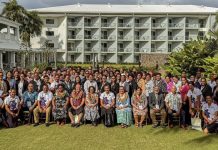
Hosted by the Tuvalu Department of Climate Change, with the support of the Secretariat of the Pacific Regional Environment Programme (SPREP) and Climate Analytics, Tuvalu officials, village elders, and key stakeholders are meeting at the Tomasi Puapua Convention Centre to set the priorities to guide the implementation of activities in the coming years.
Loss and damage, which can be divided in two categories – economic and non-economic – can result from extreme weather events such as cyclones, droughts and flooding as well as slow-onset impacts like increased temperatures, sea level rise and ocean acidification.
Historically, loss and damage assessments have concentrated on tangible economic impacts caused by disasters such as infrastructure damage or agricultural losses.
But for Pacific communities, the consequences of climate change go far beyond the economic damages. Non-economic losses and damages (NELD) can be some of the most devastating.
“In Tuvalu, and especially on Nui island, we are living the reality of loss and damage.”
Saltwater intrusion, especially from cyclones, storm surges and high tides that affect the pulaka pits, has had a devastating impact.
“The pulaka pit is our main source of survival, our sustenance and food security. When Tropical Cyclone Pam struck, all the pulaka was dead, so we had to change our way of living. We had to look at alternatives like rice and other things for survival,” Mr Petaia said.
“Another concern is the men who work in pulaka pit, once the pulaka pit is destroyed, there’s nothing for them to do. So their behaviour changes, other habits creep in like grogging because they do not have anything to do. And this has changed the pattern of their lifestyle which brings all sorts of social and economic challenges.”
According to Petaia, it takes at least five years, or more, after every disaster, for the pulaka pits to recover.
“The concern is that these disasters are becoming more frequent.”
Sea level rise and coastal erosion continue to eat away at the already small land mass on Nui Island.
“Our places of burial are disappearing, these are places that have been there since time immemorial, even before the missionaries came. We’ve had to relocate our place of burial to another part of the island, and with that comes losses we cannot place a value on.”
During the second day of Tuvalu BOLD Response Project workshop, village elders, community leaders and participants highlighted a number of NELD including the loss traditional governance system, climate-change related health issues, loss of family inheritance, loss of labour force, traditional medicine amongst other things.
Seventy-six-year-old, Penehuro Hauma, of Funafuti pointed to what he said was the most painful loss of them all.
“The worst impact of loss and damage is the loss of land. When you have no land, you have no identity. This has compounding impacts when it comes to loss and damage,” he said.
“Knowing the seasons is very important for the people of Tuvalu. In the past, we know when it is a good time to plant, we know the season to fish for certain seafood, we also know the best time to transport products between the islands.
“Even when it comes to things like water, where there was water shortage, we were able to organise ourselves in a way where we got water. The water was not just for us; it was also for our animals and plants.
“But the climate patterns have made all this very difficult. It’s very difficult now, our normal rhythm of life has been disrupted, and made worse by migration to other places, including foreign countries because we no longer have the people around that would usually help.”
Petaia and Hauma have both been very active during the conversations on loss and damage in Tuvalu this week. They welcome any assistance their communities stand to gain from the BOLD Response project.
“We are working on different ways to revive our language, and I know it’s not easy to do. The younger generation are more educated, and due to factors beyond our control, they are moving about and talking other languages such as Tuvaluan and English,” said Petaia.
“One of the things we encourage is that our people need to speak the Nuian language at the family level. They can speak other languages when they go to school because that’s necessary. Inside the maneapa (community hall), you speak Nuian only. No one is allowed to speak another language except if there are visitors who don’t understand our Nuian language.”
And despite the sobering reality climate-related loss and damage, the Tuvaluan elders remain hopeful.Hauma said the work by Pacific governments and regional organisations like SPREP to amplify Pacific voices is critical.
“In Tuvalu we are grateful for all the help we can get,” he said. “We have to keep on pushing for the high-emitting countries to be held accountable and feel responsible for our dilemma. It’s not about aid or anything, it’s about the truth and that is what is happening to us in Tuvalu, and in most Pacific countries, is a result of the greed of other countries and how they have degraded our environment. They are in position to help, and they should look upon us as the people they have wronged and do the right thing. This issue for me is about accountability.”
Petaia agreed and added: “The fact remains that as Pacific islands, we emit very little. The message has always been there for the international community, there is too much talk, they have got to walk the talk and help small island countries because we are the most vulnerable to these impacts.
“That said, we have got to be proactive, we have got to be responsible for ourselves and we have got to keep raising our voices in spaces we need to tell our stories. We don’t bark all the time for the countries to look at us; we also need to do things to look after ourselves.”
The BOLD Project work in Tuvalu this week is part of this work to ensure the protection of our Pacific communities.
For more information on the BOLD Project, please contact SPREP Climate Change Adaptation Adviser, Filomena Nelson filomenan@sprep.org, BOLD Project Manager, Malaki Iakopo malakii@sprep.org or Climate Analytics – Patrick Pringle patrick.pringle@climateanalytics.org