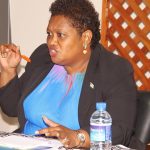
The Chair of the Forum Fisheries Committee Ministerial Meeting(FFCMM) and Niue Minister for Natural Resources, Mona Ainuu, has called for stronger alignment between Pacific Island countries and development partners to secure long-term gains from the region’s tuna resources.
Opening the Development Partners Symposium under the theme “Casting Together for Impactful and Sustainable Fisheries,” Ainuu said Pacific fisheries success has always been intentional and Member-driven.
“It is my honour, as Chair of the Forum Fisheries Committee Ministerial Meeting, to formally open this Development Partners Symposium.”
She thanked the Director-General and the Secretariat for convening the meeting under what she described as a timely theme.
“This theme captures the foundation of Pacific fisheries success: Pacific fisheries success has never been accidental. It has always been intentional, coordinated and Member-driven.”
Ainuu said fisheries are deeply rooted in Pacific identity and collective practice.
“Fisheries is deeply rooted in our DNA; the skills that have passed down from generation to generation, the knowledge that working together and sharing the fruits of our harvests with neighbours and the wider community, is no different to what we are doing together today, as we continue to collectively work together and provide for our people.”
She recalled that nearly five decades ago, Pacific Leaders made a strategic decision to act collectively in managing ocean resources — a move that has shaped the region’s trajectory.
“Today, the Pacific manages some of the most sustainably harvested tuna stocks in the world.”
“That achievement belongs first and foremost to Pacific Island countries — and it has been strengthened through partnership.”
Ainuu stressed that tuna is central to Pacific economies.
“Tuna is not merely a commodity. It is the economic backbone of many of our economies. It finances public services. It strengthens fiscal stability. It supports livelihoods. And it reinforces sovereign control over our resources.”
“For Pacific Leaders, sustainable fisheries management is not a sectoral issue. It is a development priority and a strategic imperative.”
She warned that the operating environment is changing and maintaining leadership will require adaptation.
The Pacific Islands Forum Fisheries Agency(FFA) Secretariat is currently undergoing reform following an independent review.
“The Forum Fisheries Committee has been actively considering how to strengthen the FFA Secretariat to ensure it remains fit for purpose. The independent review has provided candid and constructive recommendations. As Ministers, we view this reform process not as a critique of the past — but as an investment in the future.”
“A stronger Secretariat means stronger service delivery to Members. Stronger governance systems means Improved accountability and performance standards, and an enhanced capacity to respond to emerging challenges.”
However, she said reform alone is not enough.
“Strategic alignment between Members and development partners is essential.”
Ainuu acknowledged the longstanding support of development partners but noted that demands on both the Secretariat and Member countries continue to grow, particularly in fisheries management, monitoring, climate resilience, digital systems and value-added development.
“This Symposium therefore serves a practical purpose:
* To ensure clarity of priorities.
* To reduce duplication
* To identify gaps, and
* To mobilise coordinated support where it is most needed.”
She outlined three guiding principles for partnership.
“First, Member ownership. Regional fisheries governance must remain Pacific-led and grounded in the collective decisions of FFA Members.
Second, transparency and accountability. Resources invested must translate into measurable outcomes.
Third, long-term sustainability. Short-term projects cannot substitute for durable institutional strength.”
Ainuu said the responsibility before Ministers and partners goes beyond protecting a resource.
“The responsibility before us is not simply to protect a resource, but to uphold a governance system that has delivered global respect and regional stability. That system must remain disciplined, united and forward-looking but more importantly, adequately resourced.”
She also highlighted the Ocean Literacy Initiative endorsed by the Ministerial, stressing the need to prepare future generations.
“In addition to pursuing greater benefits for our people from our tuna resources, we need to make sure that all our people are in the vaka with us as we continue to paddle forward. We need our children to learn as early as possible because today generations will take on the responsibility of providing for their families, their people and the region in the future.”
Ainuu also urged Members open and focused engagement.
“I encourage you to use this Symposium as an opportunity to speak candidly, listen carefully and align deliberately.We are all here today because we want to work together.
“So, Let’s build on what works; Let’s refine what must improve. And let us ensure that our collective efforts deliver real and lasting impact for our peoples. Let’s cast together for impactful and sustainable fisheries,” she said