
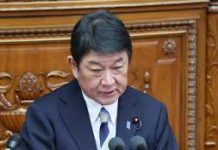

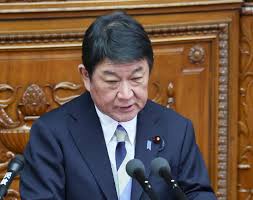
Japan’s Foreign Minister Toshimitsu Motegi has warned that the world is undergoing its most significant structural changes since the end of World War II, pledging a “Responsible Japanese Diplomacy” to safeguard peace and prosperity.
Addressing the 221st Session of the Diet on Friday, Motegi said the global security environment is shifting rapidly amid intensifying conflict and confrontation.
“Amidst the shifts in the balance of power and the intensification of conflict and confrontation, the world is currently undergoing the most significant structural changes since the end of WWII. The security environment surrounding the international community and Japan is undergoing rapidly, accelerating changes across various fields.”
He highlighted Russia’s aggression against Ukraine, instability in the Middle East, China’s military activities around Japan, North Korea’s nuclear and missile development, and growing Russia–North Korea military cooperation as serious concerns.
“With international relations remaining severe, expectations for Japan are growing. As Minister for Foreign Affairs, to promote the ‘Responsible Japanese Diplomacy’ Creating Peace and Prosperity’ advocated by the Takaichi Cabinet, and to proactively fulfill the roles and responsibilities expected of Japan by the international community across various fields, I will develop a ‘diplomacy that had inclusiveness and strength leading multifaceted and multi-layered cooperation’ which is responsive to changes in the international community.”
Motegi said the Japan-U.S Alliance remains the cornerstone of Japan’s foreign and security policy.
“The Japan-U.S Alliance is the cornerstone of Japan’s foreign and security policy, and the foundation of the peace and prosperity in the Indo-Pacific. We will further strengthen the deterrence and response capabilities of the Japan-U.S Alliance.”
He said Japan would steadily implement tariff agreements with the United States and expand cooperation in economic security and people-to-people exchanges. He also reaffirmed efforts to relocate Marine Corps Air Station Futenma to Henoko while maintaining a stable U.S presence in Japan.
“We will continue to coordinate closely with the United States at all levels, including summit and foreign minister meetings, and will also make the most of opportunities such as the Prime Minister’s visit to the United States this spring, which is currently being arranged.”
Motegi said Japan would upgrade its “Free and Open Indo-Pacific (FOIP)” strategy to reflect changing global dynamics.
“We will upgrade the ‘Free and Open Indo-Pacific (FOIP)’ as a pillar of Japanese diplomacy, adapting it to the changes in the times and new challenges encountered over the ten years since its launch.”
He emphasised strengthening cooperation with the G7, ASEAN, Australia, India, Pacific Island countries, the EU and NATO, and expanding frameworks such as the Quad.
On China, Motegi acknowledged ongoing tensions but reaffirmed dialogue.
“Our policy of comprehensively promoting a ‘Mutually Beneficial Relationship Based on Common Strategic Interests’ and building a ‘constructive and stable Japan-China relations’ with China remains consistent. Precisely because there are pending issues and challenges, it is all the more important for Japan and China to communicate with each other.”
He reiterated Japan’s position on Takeshima and stressed close coordination with the Republic of Korea.
Regarding North Korea, he was firm: “North Korea’s nuclear and missile development is totally unacceptable. Furthermore, the military cooperation between Russia and North Korea is a seriously concerning development, given its impact not only on the situation in Ukraine but also on the security of the region surrounding Japan.”
He said Japan would seek full implementation of UN Security Council resolutions and the complete dismantlement of North Korea’s nuclear and ballistic missile programmes, while prioritising the return of abducted Japanese nationals.
“Among these issues, as the abductees and their families are growing older, the return of all abductees at the earliest possible date is our top priority. We will spare no effort and utilize all available means to achieve this.”
Motegi described Russia’s war in Ukraine as “an outrageous act that shakes the very foundations of the international order,” and said Japan would continue supporting Ukraine and promoting sanctions in coordination with the G7.
On the Middle East, he said Japan would support humanitarian assistance in Gaza and work toward a two-state solution, while pursuing dialogue with Iran on nuclear concerns.
Motegi stressed closer cooperation with the Global South through ODA and security assistance.
“Through ODA, by delivering ‘visible Japanese development cooperation’, and OSA, we will advance tailored cooperation that takes into account the needs of partner countries, and also promote private investment catalysed by ODA.”
He pledged to maintain high standards of the Comprehensive and Progressive Agreement for Trans-Pacific Partnership and push for WTO reform and a “safe, secure, and trustworthy artificial intelligence (AI)” ecosystem.
Marking the 70th anniversary of Japan’s admission to the United Nations, Motegi called for UN reform, including Security Council reform, and reaffirmed efforts toward nuclear disarmament through the NPT regime.
He said Japan would continue leading on climate change, global health and disaster risk reduction under the concept of human security.
“I have now outlined my views on the challenges facing our nation and the measures we are taking to address them. I sincerely ask for the understanding and cooperation of all Diet members and the people of Japan,” said Motegi