
Australia has made its biggest Pacific sporting bet so far. Will it deliver results for both Australia and the Pacific Islands?
By Rafael Costa
In December 2024, the Australian Government pledged to invest AU$600 million (roughly US$425 million) over a ten-year period for Papua New Guinea to join the National Rugby League (NRL) by the 2028 season. This means much more than just sport. There’s a clause in the agreement that allows Australia to revoke the investment if Papua New Guinea commits to a security deal with China, meaning that the NRL has turned into an official tool of Australia’s foreign policy.
The team, the Papua New Guinea Chiefs, will be the Pacific Islands’ first franchise in Australia’s major rugby league and was offered a dedicated compound for players and their families in Port Moresby. Anthony Albanese, Australia’s prime minister, announced it using undeniably diplomatic language: “Rugby league is PNG’s national sport, and PNG deserves a national team.” Papua New Guinea’s Prime Minister James Marape went in the same direction by confirming that the country had made a “deliberate choice to have Australia as a security partner of choice” before signing the deal.
However, the money and the conditions aren’t the only elements making this deal meaningful. The Papua New Guinea Chiefs project is the product of a decade of Australia’s institutional development to systematically convert sports into a soft power tool for its government.
The structuring of Australian sports diplomacy started in 2015, when Canberra launched what was considered the earliest national strategy for sports diplomacy in the world. That was complemented with projects such as PacificAus Sports, a leading program created in 2019 that reached more than 850 athletes in 120 events in Tonga, Solomon Islands, Vanuatu, Papua New Guinea, and Fiji.
Australia and New Zealand joined the Pacific Games for the first time in that same year. Moreover, the Australian government’s funding for the Fijian Drua men and women’s teams led both to join Rugby Pacific, where the women’s team won back-to-back championships in 2022 and 2023.
Tim Watts, assistant minister for Australian Foreign Affairs, continued this institutional drive. In November 2024, he led the creation of the Sports Diplomacy Consultative Group, a mechanism meant to connect the Department of Foreign Affairs and Trade (DFAT) with 22 sport organizations covering multiple sports (such as golf, rowing, surfing, and baseball, among many others).
In February 2025, this step was followed by the publishing of Australia’s “Sports Diplomacy Strategy 2032+,” which explicitly acknowledges sports as “an important source of national power” and a major component of foreign policy. The document’s timing is grounded on what the Australian government refers to as “the green and gold decade,” culminating in hosting the 2032 Brisbane Olympics.
The urgent character of Australia’s development of sports diplomacy is clearly fuelled by China’s increasing impact in the Pacific region. The Pacific Games Stadium in Honiara, Solomon Islands – built by China for the Pacific Games in 2023 at an estimated cost of US$70 million – demonstrates how China is pursuing its own sports diplomacy goals in the region. Around the same time, the China-Solomon Islands security agreement signed in April 2022 alarmed Western countries and increased Australia’s worries about weakening its influence in such a strategically important region.
However, Australia’s reaction was not a sudden U-turn. The NRL deal with Papua New Guinea builds on an established infrastructure: Rugby Australia collaborations, PacificAus Sports, and consultative instruments linking sports actors with the government.
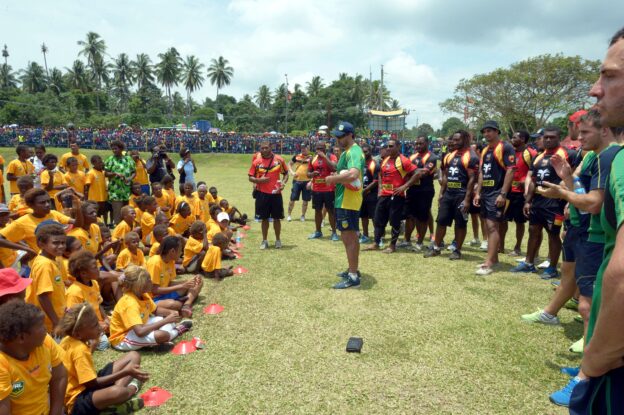
Sports provides Australia with true leverage. Rugby league is Papua New Guinea’s national sport, a unique case in the world, and players from the Pacific Islands are central to the NRL, making the cultural links undeniable. Yet, the cultural element is not automatically converted into diplomatic results, and mutual love for the game is not a guarantee of strategic alignment. This is exactly why institutional frameworks are so important, as an effort to transform soft power resources into clear strategies, coordinated policies, sustainable investment and measurable initiatives.
Australia’s approach can be compared with Japan’s, whose sports diplomacy is rooted within the Japanese Ministry of Foreign Affairs. The “Sport for Tomorrow” program, created by the Japanese government in 2014 and aimed at being a Tokyo 2020 Olympics legacy project, reached over 204 countries and 13 million people. Japan launched a dedicated Sports Agency in 2015 to promote sports and coordinate sports policy that was previously dispersed across different ministries. This Japanese model proves what constant, sustainable institutional alignment can lead to: using sports events not simply as an exhibition show, but also as a stage for diplomatic engagement throughout a whole region.
Australia is now following a similar pathway, aiming at the 2032 Olympics in Brisbane. Of the AU$600 million dedicated to the agreement with Papua New Guinea, AU$290 million is meant to fund the franchise, whereas AU$250 million will go toward developing rugby league programs within Papua New Guinea, Fiji, Samoa, and Tonga. The investment goes further than just a single team: it foresees a regional growth program with sports at the core. This is precisely the aligned sustainable approach that differentiates improvised action from strategic sports diplomacy.
The Papua New Guinea Chiefs will start competing in 2028 and by that time, Australia will be immersed in the arrangements for the Olympics, with numerous international sports events coming in the near future. The foundation is already laid: a decade of institutional development, a consultative group merging government with sports, an official national strategy acknowledging the power of sports as a tool of soft power. The question is whether Australia can execute this approach and develop the sustainable investment, coordination, and political drive needed to generate solid benefits for the Pacific region and not only fulfil Australian interests.