
Warnings that Beijing is actively targeting Pacific democracies have intensified in the United States.
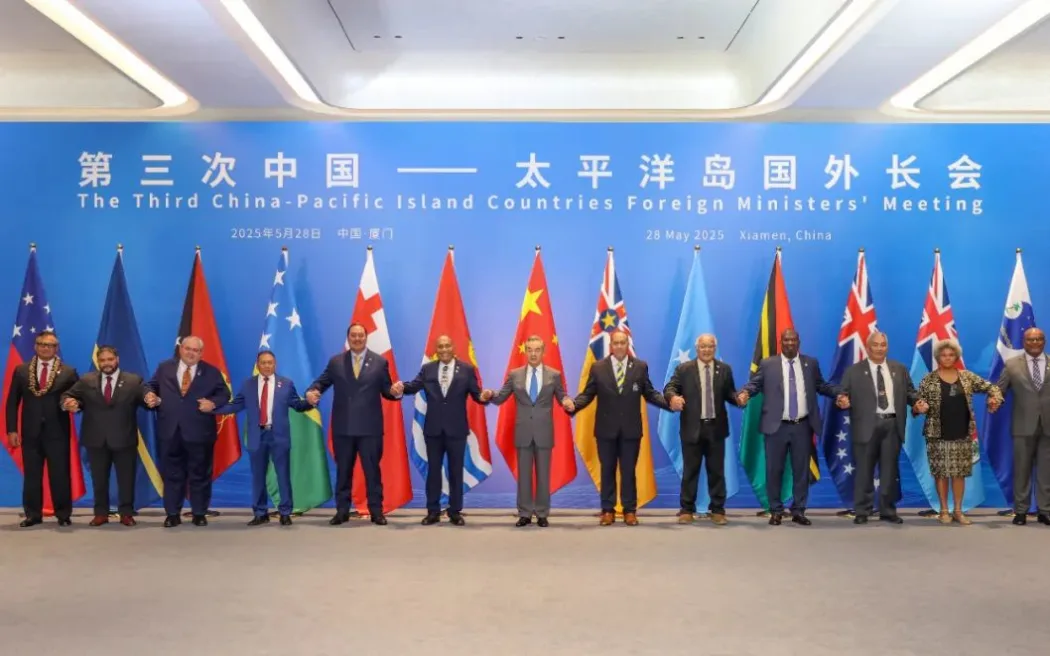
As Washington renews its strategic compact ties with three Micronesian nations, there is growing concern over China’s political, economic, and security footprint across the region.
Pacific security analyst Robert Underwood, chairman of the Pacific Center for Island Security and a former U.S congressional delegate from Guam, said Washington DC’s latest warnings about China echo long-standing concerns but still fall short of a coherent economic strategy for the region.
“There is no U.S policy to economically invest in the COFA states,” Underwood said. “There is only the promise of government-to-government assistance. It lacks imagination.”
Edward Camacho, special assistant for military affairs for the Commonwealth of the Northern Mariana Islands, said the issue is not China as a nation but the methods used by the Chinese Communist Party to expand influence in small island states.
“China and the Chinese people are generally not a threat at all,” Camacho said. “But the CCP and its cronies – including PLA personnel posing as diplomats and businesspeople – are creating misleading deals with heads of state and major businesses across the Pacific and beyond.”
The latest warnings from the U.S follow testimony in Washington, DC by Angel Demapan, deputy assistant secretary for insular and international affairs at the U.S Department of the Interior, who said China is waging a sustained influence campaign aimed at weakening democratic institutions and strategic alignment in the Pacific.
Testifying before the U.S House Committee on Natural Resources, Demapan said the Compact of Free Association (COFA) agreements are “more important than ever” as Beijing expands its efforts to shape political outcomes and decision-making across the region.
“The PRC has deployed an extensive influence operation aimed at corroding, corrupting and coercing democracies,” Demapan told lawmakers.
China has repeatedly rejected allegations about undue influence and said its cooperation with Pacific Island countries is open, transparent and does not target any third party.
The compacts bind the United States to Palau, the Republic of the Marshall Islands and the Federated States of Micronesia – collectively known as the freely associated states – and form the backbone of Washington’s military access and strategic presence in the north Pacific.
Under COFA, the United States provides economic assistance and assumes responsibility for defence, while retaining exclusive military access across vast areas of the Pacific. In return, citizens of the three nations can live, work and study in the United States without visas.
Northern Mariana Islands Delegate Kimberlyn King-Hinds told the hearing that the agreements should be understood as a strategic exchange rather than foreign aid.
“The COFA agreement was never designed as foreign aid in the traditional sense,” King-Hinds said. “It was a strategic bargain. The United States receives critical defense and security rights in the Pacific, and in return commits to helping ensure these nations are economically stable, self-governing and resilient.”
After years of funding uncertainty, the U.S Congress passed the Compact of Free Association Amendments Act in 2024, authorising US$6.5 billion in economic assistance over 20 years.
Demapan said about US$1.5 billion has already been released under the renewed compacts, with funding overseen by the Department of the Interior’s Office of Insular Affairs.
He said depopulation – driven by limited economic opportunity and access to services – remains the most serious long-term threat to the freely associated states.
“The COFA agreement offers a platform to strengthen these economies, improve livelihoods, healthcare, education outcomes and critical infrastructure,” Demapan said.
He added that investments are being directed toward schools, health facilities, ports, and power systems, with about US$750 million issued since the new agreements entered into force.