


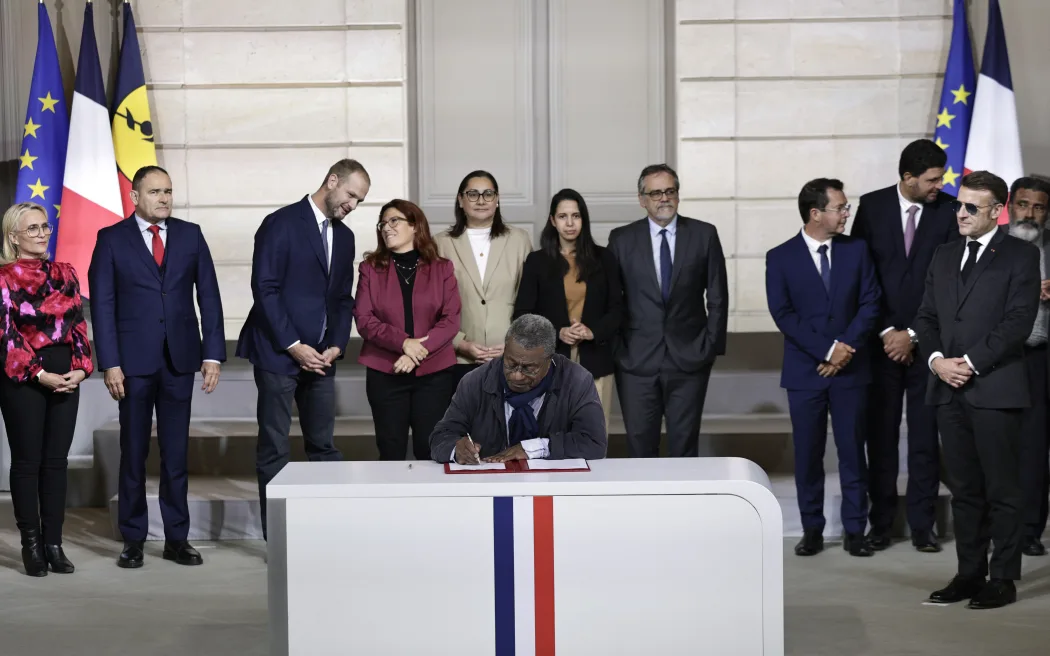
New Caledonia’s politicians and French President Emmanuel Macron have signed a new political and financial agreement concerning the French Pacific territory.
The Elysée-Oudinot Accord was signed by most of New Caledonia’s political leaders represented at New Caledonia’s local Parliament, the congress.
But one of the main pro-independence movements, the FLNKS, had boycotted the talks, and a later request to attend remotely was declined.
The agreement, now renamed “Elysée-Oudinot” (Oudinot being the name of the street where the French Minister for Overseas is located in Paris), was signed on Monday evening (local time).
The signing followed four days of tense negotiations behind closed doors at the French Ministry for Overseas, which lasted until late at night on Saturday and Sunday.
It is mainly based on a former deal signed in July 2025, in the small city of Bougival (west of Paris).
It aims at bringing clarifications and additions to the earlier text, which was also rejected in block by the pro-independence FLNKS party.
The signing concludes “three days of in-depth discussions” in a “spirit of demanding and respectful dialogue” which “allowed for a shared path for the evolution of New Caledonia’s institutions to emerge”, a statement from the French President’s Office, the Élysée, said.
Speaking during a brief signing ceremony, Macron expressed his “congratulations” and “gratitude” to the participants for their sense of “compromise” and “responsibility”.
He also hailed their “courage”, despite the “unacceptable threats several of you have been subjected to”.
Referring to threatening messages posted on social networks in recent days, he said the targeted politicians “have the support of the Republic” and persons who have posted such threats “will be prosecuted”.
Other notable additions to the text are related to New Caledonia’s institutional future developments.
Some of these were related to the indigenous Kanak people’s identity, and a reaffirmation of what was already written and enshrined in the 1998 Nouméa Accord preamble.
The new text goes further in introducing the notion of a “Caledonian identity”, which is supposed to “allow all [New] Caledonians to form a “people”.
Another paragraph pledges to work on New Caledonia’s attractiveness for the purpose of its “economic development” and to give relevant powers to its three provinces to achieve this goal.
Another new notion is de facto enhancing the capacity of the three provinces (North, South and the Loyalty Islands group) to raise their own taxes.
Other subjects discussed included the notion of self-determination, key powers (such as defence, security, external relations, justice and currency) and how they should be exerted in future.
This would come with the associated training of local elites in the diplomatic, military, law enforcement, judiciary and financial elites.
Other parts, also signed earlier on Monday in the form of a “summary of conclusions”, were related to New Caledonia’s dire financial situation and the way France intended to assist in future through a “refoundation” pact to the tune of €2.2 billion (US$2.56 billion) over the next five years.
However, New Caledonia’s institutions would still have to pursue their efforts, which have already started, in terms of economic reforms and cost-cutting.
New Caledonia’s economy has been left in a dire situation, following the riots which broke out in May 2024.
As part of the new text, a significant commitment is pledged by France to convert earlier heavy loans into grants.
This mainly concerns those loans contracted due to the COVID-19 crisis and the May 2024 riots (US$1.16 billion).
The new agreement still has to go through the French parliament and a referendum vote in New Caledonia.
If the text receives sufficient support from the French Parliament, it also entails that crucial provincial elections (already postponed three times since 2024), would now be once again rescheduled to the last quarter of 2026.
Those elections, which are the foundation of the whole political system in New Caledonia, were initially supposed to take place in May 2024.
Also, in terms of schedule, the new text envisages that it would be gazetted this month, then put to the vote of both house of the French Parliament – the Senate in February 2026, then the National Assembly (March-April 2026), then both Houses in a “Congress” format for Constitutional amendment purposes.
In June-July 2026, a de facto referendum would submit the text to the vote in New Caledonia with eligible voters. If a majority approves, this will open the door to Constitutional amendments coming into force.
Other related amendments and additions include the implementation of an “organic law” and a “fundamental law” (a de facto Constitution) for New Caledonia.
The initial text signed in Bougival also mentions the notion of a “State of New Caledonia” with its associated “nationality”, albeit conditioned to the prior possession of the French citizenship.
Also on Monday, French Prime Minister Sébastien Lecornu announced that, faced with a hung parliament with no clear majority, he had now resolved to resort (although he has initially pledged not to) to engaging the responsibility of his government (pursuant to Article 49.3 of the Constitution) to have France’s Appropriation Bill (budget) finally endorsed and to pass.