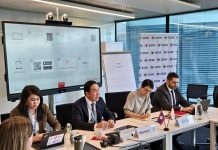
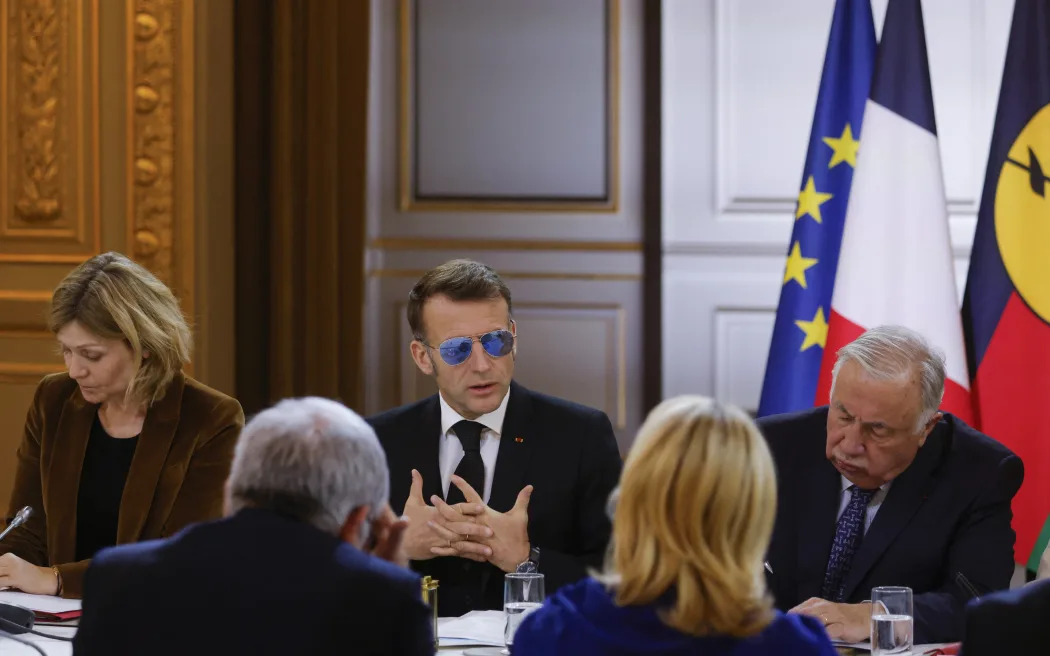
Talks on New Caledonia’s political future have been underway in Paris after French President Emmanuel Macron launched a fresh roundtable on Friday, despite the absence of one of the French territory’s main pro-independence groups, the FLNKS.
During a first meeting with New Caledonia’s political stakeholders, Macron “regretted one of the political partners did not wish to respond to our invitation”.
But he said more talks were needed to “reach an agreement to get out of an already too long uncertainty”.
“Today, the State wishes to continue to advance on stabilising New Caledonia’s institutions, as part of a dialogue respectful of everyone, without any forceful passage, but without any paralysis either,” the French president said.
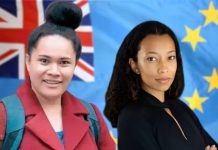
New Caledonia’s Congress (Parliament) Speaker Veylma Falaeo (Wallisian-based Eveil Océanien party) echoed Macron’s remarks, saying she too regretted the FLNKS’ absence “but it’s now time to move forward”.
Eveil Océanien leader Milakulo Tukumuli suggested politicians should agree on a “new period of stability of 15 to 20 years to rebuild and reform [New Caledonia], after which a new referendum could be held on a new common project or even an associated state”.
“[Macron] has now considered that one could not eternally wait for people who are not here around the table and that therefore we had to move forward because, and we told him once again, either we move forward or New Caledonia is sinking,” Pro-France Virginie Ruffenach (Rassemblement-LR) told French media.
The FLNKS, which last week decided not to travel to Paris for the talks, had however, formulated a late request to join in remotely.
The request was not entertained.
During the same opening session dedicated to each party’s statement, the most confrontational ones came from the two main pro-France MPs, who have also recently become increasingly critical of the French President.
“We have done our part. We have negotiated; we have made concessions; we have taken our responsibilities. Now it’s on you to do your part,” Les Loyalistes leader Sonia Backès told the gathering on Friday.
“Those who don’t want any agreement have already made us lose precious time.
“We are here because the [French] state did not engage sufficient forces on 13 May 2024.”
She was referring to the insurrectional riots that killed 14, damaged or destroyed hundreds of businesses and the loss of thousands of jobs for a total of some €2.2 billion (US$2.55 billion) in damages.
She said the text, even if it was to be modified, was about “choosing what kind of society we want… Either it’s the rule of the strongest or it’s a victory for democracy”, she told Macron.
Another pro-France outspoken politician, New Caledonia’s MP in the National Assembly Nicolas Metzdorf, said: “Mr President, I don’t really know what we are doing here today. We never requested this meeting… Because as far as we’re concerned, we did everything that had to be done. We have worked. We have negotiated. We have made concessions.
“Instead, you should have convened the [French] ministers and parliamentary groups who remain… paralysed by fear.”
Metzdorf went further in accusing France of being “unable to enforce the basic principles of democracy when it comes to one of its own territories”.
“As far as we’re concerned, we have reached the limits of what is acceptable. Now things are simple and perfectly clear: either we come out of this sequence [of discussions] with a precise text, a clear schedule and endorsement by Parliament or we will radically change our strategy and we’ll turn against our own state by using all means available to us.”
He was alluding to suing the French state in the European Human Rights Court of Justice, in reference to current restrictions to New Caledonia’s electoral roll at provincial elections, as prescribed under the previous 1998 Nouméa Accord.
This is the criteria that limits the number of eligible voters at provincial elections to those born or residing before 1998 and their descendents.
“Mr President, we have nothing left to lose… Because we can see the Republic has no more promise left for us,” Metzdorf added.
However, he appeared to remain optimistic: “With [pro-independence] UNI, we’ll find a point of equilibrium in the next few days.”
Moderate pro-independence leader Jean-Pierre Djaïwé, who belongs to the UNI (Union Nationale pour l’Indépendance, a gathering of PALIKA -Kanak Liberation Party- and UPM -Union Progressiste en Mélanésie-) who broke away from FLNKS and supported the Bougival text, said in Paris his aim was to “improve what can be improved”.
But other party leaders, like Philippe Dunoyer (from moderate pro-France Calédonie Ensemble), said any new agreement would remain meaningless without substantial French financial backing.
New Caledonia’s MP in the French Senate, Georges Naturel, made an outright call to Macron, asking him to be “lucid” and recognise that it is “impossible to implement” the 12 July 2026 agreement project within its original schedule.
Macron did not respond to the comments before departing the session.
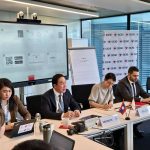
After an initial sequence on Friday, marked by declarations by Macron and the main political parties in attendance, both pro-France and pro-independence, the session then split into workshops hosted by the French Ministry for Overseas, under the supervision of its Minister, Naïma Moutchou.
The talks are focusing on several aspects of the implementation of an earlier project agreement signed in July 2025.
The text, in its initial form, was mentioning the creation of a “State of New Caledonia” with its correlated “nationality” and a mechanism of gradual transfers of more powers from France to New Caledonia.
The specific themes discussed this month include the notions of the transfer of powers from France, self-determination, defence, security, external relations, the recognition of the indigenous Kanak identity and further financial assistance under a “refoundation pact” proposed by France for a total of €2.2 billion (US$2.55 billion) over a 5-year period.
The final aim remains to arrive at a new document bearing “clarifications” to the initial pact signed in July 2025, under the label of “Bougival”.
But the Bougival text has since faced several major obstacles in its implementation process.
This includes its outright rejection by the pro-independence FLNKS (Kanak and Socialist National Liberation Front), while all other New Caledonian parties have decided to support the project at various levels.
FLNKS calls the July 2025 project a “lure of independence” because it does not address its demands for a short-term full sovereignty.
Another major obstacle was the division within the French Parliament, still faced with the absence of a clear majority, which has also delayed the endorsement of the French 2026 Appropriation Bill (budget).
Another objective of the talks is to have the revised project quickly endorsed by the French National Assembly (Lower House) in February and by the Senate (Upper House) mid-April and a final joint meeting of both House, under a “Congress” format to have the final document approved to modify the French Constitution.
If all those modifications eventuate, the next document would be renamed “Elyséee-Oudinot” and the original name of “Bougival” scrapped.
Speaking on Sunday, FLNKS political bureau member and member of Union Calédonienne, Gilbert Tyuienon, denounced the Paris talks, saying this was not in line with the previous agreement signed under the name of “Nouméa Accord” in 1998, which paved the way for a decolonisation process for New Caledonia.
He said even if the Paris talks produced a new, revised document, it remained highly doubtful that it could be endorsed by French MPs “because President Macron doesn’t have a majority in Parliament”.
Another difficulty, he said, was that under the revised roadmap, New Caledonia’s provincial (local) elections could be postponed for the fourth time to sometime in September 2026.
But he pointed out that, when it gave its final green light to the former postponement to no later than 28 June 2026, the French Constitutional Council made it clear this should be the last time the crucial poll was rescheduled.
Back in Paris, talks were scheduled to continue on Monday and possibly conclude on another session supervised by Macron, should a new document emerge.