The Solomon Islands has become the first Pacific Island country to initiate the IUCN Green List certification process for a community-managed marine area, marking a significant milestone for regional conservation efforts.
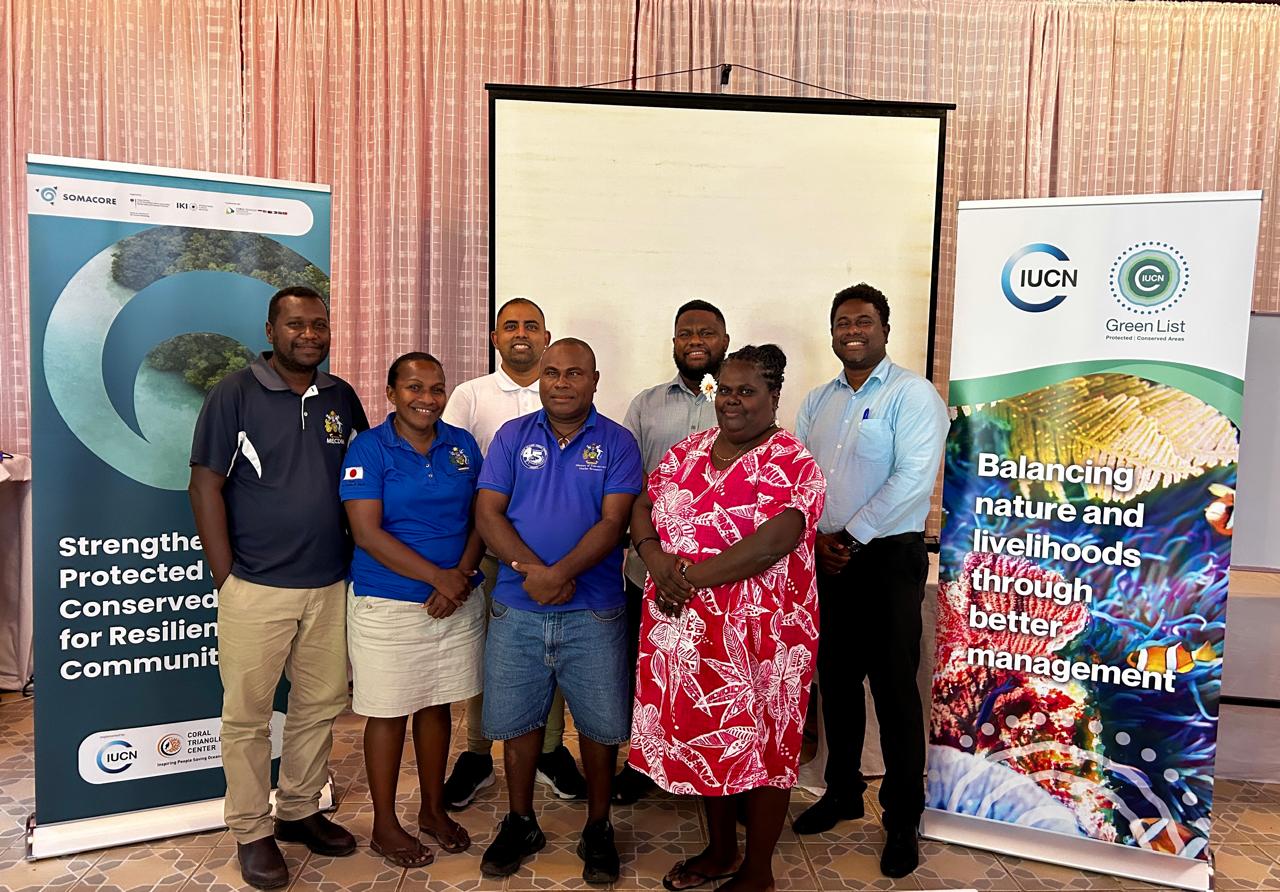
As part of the process, IUCN technical experts spent two days in Honiara delivering awareness-raising and training sessions on the IUCN Green List Standard and Certification Process.
The sessions were coordinated by the Ministry of Environment, Climate Change, Disaster Management and Meteorology (MECDM) and brought together key stakeholders, including the Ministry of Fisheries and Marine Resources (MFMR), Global Fish, the Coral Triangle Initiative on Coral Reefs, Fisheries and Food Security (CTI-CFF) Regional Secretariat, representatives from the Arnavon Marine Protected Area, and Ecological Services Solomon Islands (ESSI).
Following the Honiara sessions, the IUCN team travelled to Munda in Western Province to work directly with communities and site managers of the Munda Lagoon Locally Managed Marine Area (LMMA). The visit aimed to complete a Green List Self-Assessment, an essential step in evaluating how the site aligns with globally recognised standards of effective and equitable area-based conservation.
Munda is the largest community on New Georgia Island, located at the southwestern tip of the island adjacent to the Roviana Lagoon. The Munda LMMA encompasses five coastal communities—Nusa Roviana, Dunde, Kekehe, Lodumaho, and Kindu—and is supported by Wildlife Conservation Society (WCS) Solomon Islands. The communities jointly govern the area through customary stewardship and collaborative management arrangements, protecting critical habitats such as seagrass meadows, coral reefs, and fish spawning areas.
During the assessment, IUCN experts observed that the Munda LMMA aligns strongly with several core components of the IUCN Green List Standard, particularly in relation to community governance, recognition of customary rights, adaptive management, zonation, and participatory rule-making.
Rahul Chand, Protected and Conserved Areas Programme Coordinator for IUCN Oceania, noted that the site shows strong potential to achieve Green List certification.
“We are here to use the IUCN Green List Standards and help the community undertake a self-diagnostic assessment to better understand and be informed about their site, particularly around the management effectiveness, sound design and planning, governance and conservation outcomes which can help build a world class conservation site,” Chand said.
Dr Olivier Chassot, IUCN’s Green List expert said that the LMMA is a strong Green List candidate site but would require targeted improvements to achieve certification. In doing so he provided detailed information to the site managers on areas of improvement.
IUCN plans to return to Munda in early 2026 to continue supporting site-level managers and to undertake a similar Green List assessment at the Arnavon Marine Protected Area. Both Munda and Arnavon were nominated by the Solomon Islands Government under the CTI-CFF regional programme of work, supported by the SOMACORE Project.
The SOMACORE Project aims to implement the IUCN Green List Standard across six Coral Triangle countries – Indonesia, Timor-Leste, Malaysia, the Philippines, Papua New Guinea, and the Solomon Islands – providing a globally recognised framework for effective and equitable management of selected marine protected and conserved areas. The project also focuses on strengthening the capacity of local communities and stakeholders, while facilitating regional learning and exchange through platforms such as PANORAMA Solutions. Its primary regional partner is the CTI-CFF Regional Secretariat.
By combining customary marine stewardship with international conservation standards, the Solomon Islands is setting a powerful precedent for community-led marine conservation across the Pacific.
The SOMACORE Programme is supported by the German Federal Ministry for Environment, Climate Action, Nature Conservation and Nuclear Safety (BMUKN) through the International Climate Initiative (IKI) and is being implemented by 10 organisations across the Coral Triangle.