

If multilateralism is to prove its worth, it must deliver first for those who have the most to lose. Our islands, our people, and our shared blue continent depend on it.
With those words from Mosese Bluewave, Fiji’s Minister for Environment and Climate Change, Pacific Ministers, Government officials and delegates have joined their counterparts from around the globe at the meeting of the highest decision-making body on environment in the world, the UN Environment Assembly for its seventh session (UNEA-7) in Nairobi, Kenya.
Held at the United Nations Environment Programme (UNEP) headquarters in Nairobi from 08 -12 December 2025, UNEA-7 guided by the theme, “Advancing sustainable solutions for a resilient planet,” opened on Monday.
Minister Bulitavu and Pacific delegations are amongst 6,000 participants from more than 180 countries, gathering to discuss sustainable solutions at a time when the world continues to struggle with the worsening impacts of the triple planetary crisis of climate change, pollution, and biodiversity loss. Pacific communities, who contribute the least to the causes of the crises, are at the frontline of these devastating impacts.
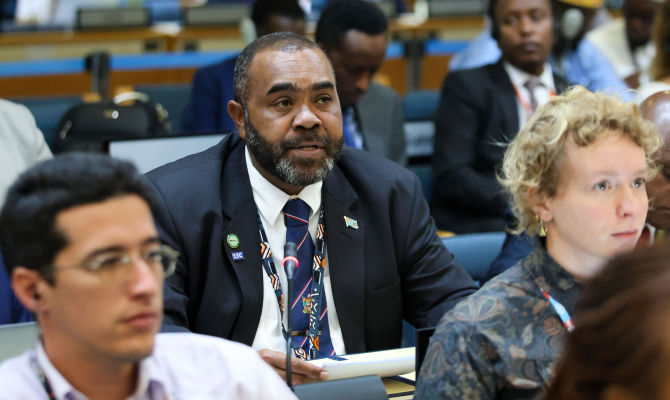
Speaking on behalf of the Pacific Small Island Developing States during UNEA-7’s opening plenary, Bulitavu reminded that Pacific countries are experiencing the triple planetary crisis in real time.
“The Pacific is facing the triple planetary crisis in real time,” said Bulitavu.
“Climate change is reshaping our coastlines. Ocean warming and acidification are degrading our fisheries and coral systems. Plastic pollution is entering our food chains and communities. Biodiversity loss is eroding the resilience that has sustained island societies for generations.
“But let me be absolutely clear; the Pacific refuses to be defined by vulnerability alone.
“We are implementing transformative changes despite facing fiscal constraints, severe climate impacts, and escalating environmental pressures. This is why UNEA-7 matters. This Assembly cannot be a meeting of comforting phrases. It must be a place where decisions reflect the true scale of the crisis, and where ambition is backed by meaningful support.”
UNEA meets biennially to set priorities for global environmental policies and develop international environmental law.
The Assembly provides leadership, catalyses intergovernmental action on the environment, and contributes to the implementation of the UN 2030 Agenda for Sustainable Development.
UNEA-7 is negotiating 15 draft resolutions on issues ranging from saving the world’s glaciers to reining in massive seaweed blooms and reducing the environmental impact of artificial intelligence.
While not legally binding, UNEA-7 resolutions help countries find common ground and have in the past laid the groundwork for precedent-setting international agreements.
Inger Andersen, UNEP Executive Director, urged all delegates to step down from “the ramparts of individual positions and meet on common ground,” in the face of accelerating environmental challenges and turbulent geopolitical waters.
“This Assembly must dig deeper than ever, because environmental challenges are accelerating. The rise in average global temperatures will likely exceed 1.5°C within the next decade, bringing escalating consequences with every fraction of a degree,” she said.
“Ecosystems are disappearing and land is degrading. Dust storms are intensifying. Toxins continue to pollute our air, water and land. And this Assembly must dig deep, because the world is in turbulent geopolitical waters, which adds stresses and strains to multilateral processes.”
She added: “We all want the same thing: a better future for ourselves and for our families. This means a stable climate; a safe, clean and sustainable environment; and a pollution-free future.”
The Secretariat of the Pacific Regional Environment Programme (SPREP) is providing support to amplify Pacific voices at UNEA-7.
SPREP’s Head of Delegation at UNEA-7 and Director of Waste Management and Pollution Control (WMPC), Anthony Talouli, reiterated that UNEA being the highest decision-making body on the environment in the world, it is critical for Pacific countries to take their seat at the table.
“SPREP stands with our Members in supporting them at the table here at UNEA-7,” said Talouli. “And when the work in Nairobi is done, we look forward to continuing to undertake actions on the ground in the region to assist our Pacific communities.”
UNEA-7 was preceded by a Major Groups and Stakeholders Forum, a Cities and Regions Summit and a Youth Environment Assembly.