
By Pita Ligaiula in Manila, Philippines
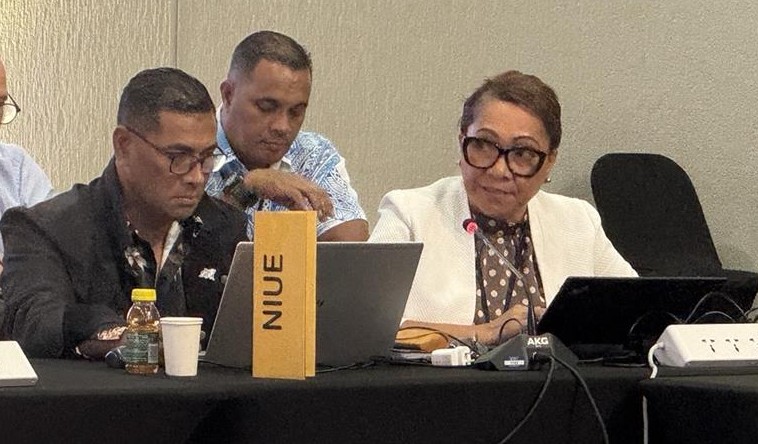
Niue’s Minister of Natural Resources and Pacific Political Climate Champion for Oceans, Mona Ainuu, delivered a sharp warning to delegations at WCPFC22, calling on the Tuna Commission to take climate science seriously and adopt long-overdue measures, starting with the South Pacific albacore management procedure(SPA MP).
Ainuu said Niue “strongly advocate[s] for the adoption of a SPA MP at this meeting,” describing it as “fundamentally important” to her country.
Turning to climate change, she did not mince words.
“Climate change is not a distant warning; it is our lived reality. Our islands face rising seas, warming oceans, and increasingly severe storms,” she said.
Ainuu said the weak climate outcome from COP30 in Brazil was “a disappointment to the small island states, to say the least, and a stark contrast with the international court of justice advisory opinion on the global climate crisis.”
She told the Tuna Commission she expects better from the fisheries sector.
“I am optimistic that we will do better here in this critical sector, to provide realistic and positive measures to govern all interests.”
Ainuu warned that COP30 showed “some in the global community prioritise their vested interests over the state of the planet and our future,” and urged WCPFC members to step up.
“As the chair of the Forum Fisheries Committee and the Pacific Region Climate Change Political champion for the Oceans nexus, I call on our partners at this table to be serious, to be science-based, and to work with us in partnership and ensure that this commission fulfils its responsibility to maintain the health, vibrancy and the sustainability of these vital tuna stock in our blue pacific ocean. After all, supplying 60 percent of the world’s tuna, should be a good enough reason.”
Ainuu said Niue is ready to negotiate but expects firm action.
“Niue stands ready to work with all Parties as a constructive and determined partner. But we also stand firm in our message: Create and operationalise relevant management measures, to protect the Ocean and our resources.”
She also invoked the International Court of Justice’s climate advisory opinion, calling on members “to uphold the legal and moral obligations… to safeguard our ocean, and deliver the climate design required to keep our communities safe and resilient.”
Ainuu criticised global climate negotiations for being derailed by “fossil fuel lobbyists and dis-ingenuous climate wars.”
“We are fisheries people. We act on science, and knowledge. Let us who bear the greatest impacts help shape the solutions we urgently need,” she said.
Ainuu then delivered the Forum Fisheries Agency (FFA)statement, highlighting rising risks identified by SPC’s climate and ecosystem indicators.
“FFA Members underscore the critical value of ecosystem and climate indicators… and we express serious concern regarding the increasing trends in sea surface temperature, warm-pool area, ocean heat content, and marine heatwaves,” she said.
The FFA also acknowledged the value of the Climate Change Vulnerability Assessment but said the full framework “is not feasible at this stage without substantial new resources” and should be integrated into existing Commission processes rather than creating parallel workstreams.
“FFA Members encourage the incremental integration of climate considerations into current workflows,” Ainuu said, reaffirming that the Pacific will continue pushing climate risk into core fisheries decision making.
“We emphasise the importance of improving our understanding of climate risks within the existing WCPFC structures through the Scientific Committee, the Technical and Compliance Committee, and the Scientific Services Provider rather than establishing a parallel process,” she said.