


By Pita Ligaiula in Manila, Philippines
Pacific members of the Forum Fisheries Agency (FFA) say they are entering WCPFC22 with a united front, determined to secure the South Pacific albacore management procedure and push back against high-seas transshipment practices they say undermine regulation, weaken development opportunities and expose crews to abuse.
In its “Pacific Voices” series, FFA highlighted the priorities of its members as negotiations intensify at the Western and Central Pacific Fisheries Commission in Manila this week.
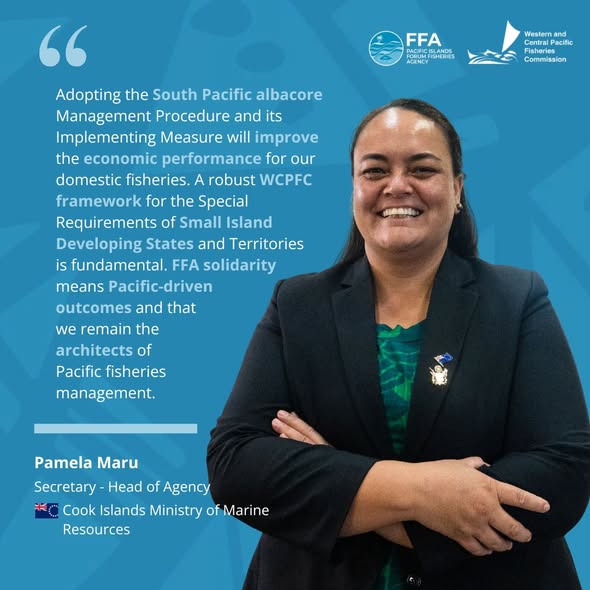
Cook Islands’ head of the Ministry of Marine Resources Pamela Maru said the albacore package is essential for the region’s domestic fleets and for safeguarding the role of Small Island Developing States (SIDS) in the fishery.
“Adopting the South Pacific albacore management procedure and its implementing measure will improve the economic performance for our domestic fisheries,” she said.
“A robust WCPFC framework for the Special Requirements of Small Island Developing States and Territories is fundamental. FFA solidarity means Pacific-driven outcomes and that we remain the architects of Pacific fisheries management.”
Tuvalu Fisheries Authority Managing Director Sam Finikaso said his country wants the albacore measure adopted and for the Commission to finally take hard action on high-seas transshipment.
“For Tuvalu, we are really hoping that the Management Procedure for Albacore is approved and adopted at this meeting,” he said. “We believe that this fishery is very important to the wider FFA group and FFA Members have put a lot of work and effort into this.”

He did not hold back on transshipment.
“We also like to see progress in the control of high seas transshipment. There is nothing good about this activity – it weakens our regulatory framework, it helps to hide IUU fishing, it encourages labour abuses, undermines SIDS’ interest in their domestic development aspirations and deprives very small countries like Tuvalu of the economic benefits we would have get from transshipment in our port. It is high time that WCPFC clamps down on this.”
Samoa’s Assistant Chief Executive Officer Roseti Imo said the proposed albacore management procedure has been tested, debated and refined — now it needs approval.
“Working together through the FFA significantly strengthens our national priorities and shared Pacific objectives at the Commission,” she said.
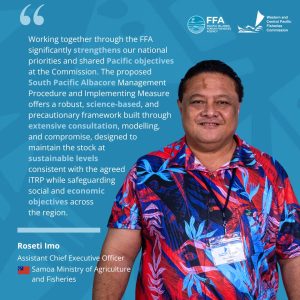
“The proposed South Pacific Albacore Management Procedure and Implementing Measure offers a robust, science-based, and precautionary framework built through extensive consultation, modelling, and compromise, designed to maintain the stock at sustainable levels consistent with the agreed iTRP while safeguarding social and economic objectives across the region.”
Tokelau’s Licensing and Access Manager Solomon Ionatana said his country supports the albacore measure despite the stock not being a major domestic fishery.
“For us as an FFA Member, one of the main priorities at this Commission is the South Pacific albacore Management Procedure and the associated conservation and management measures,” he said.

“These are important to ensure the long-term health of the stock and its effective management.”
He said supporting the wider region is key.
“While albacore is not a major stock for Tokelau, it remains a priority for us because we receive an allocation and we recognise its importance to the region. This is something we support for the benefit of all Members. As we always say, we are stronger when we go together as an FFA bloc than when we act individually,” said Ionatana.
The FFA bloc is expected to play an important role as WCPFC22 negotiates the albacore deal and debates tightening controls on high-seas transshipment — two of the most contentious issues on the table this week.