



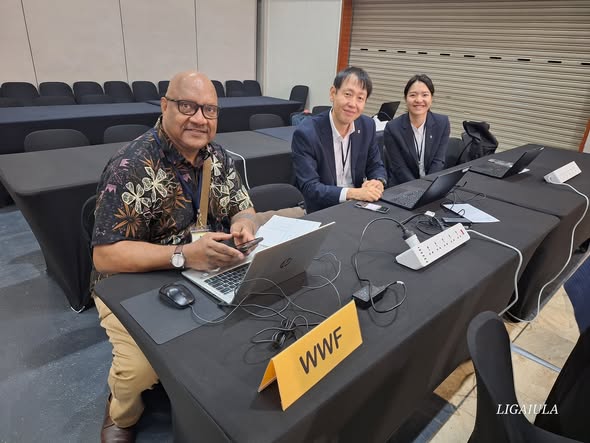
By Pita Ligaiula in Manila, Philippines
WWF has issued one of its strongest warnings yet to the Western and Central Pacific Fisheries Commission (WCPFC), telling members gathering in Manila this week that the region’s tuna fishery cannot be sustainably managed without final action on observer coverage, transshipment controls, harvest strategies and FAD management.
In a position paper submitted to WCPFC22, WWF says the Commission’s continued failure to fix monitoring gaps is “the single largest obstacle” to effective tuna management and urges members to stop delaying measures that are central to the world’s biggest tuna fishery.
“The lack of sufficient on-the-water monitoring is one of the biggest obstacles to the sustainable management of global tuna and ecosystem resources, protecting and conserving associated marine species, particularly those species of concern, and building transparent and verifiable supply chains that inspire consumer confidence,” WWF told the Commission.
WWF said the Commission is not meeting its obligations under the WCPF Convention because members have not ensured the “best available scientific evidence” is produced through adequate data collection.
“Recent efforts by the Pacific Community to standardise observer coverage-data indicate that region-wide observer coverage is barely above five percent,” the paper says.
WWF says that level of coverage is “statistically and practically useless” and contributes to poor science, weak compliance, and a free pass for illegal fishing.
“At just five percent, current observer coverage is not producing the quality or quantity of data necessary to properly manage the WCPO non-purse seine tuna fisheries,” WWF said.
The organisation also warns that low coverage deepens distortions caused by the “observer effect,” where fishing behaviour changes when observers are present.
WWF says only 100 percent monitoring human or electronic can remove bias and give managers reliable information.
“Only an observer coverage rate of no less than 100 percent, through human observers or electronic monitoring, is acceptable,” WWF said.
It is calling on the WCPFC to adopt a mandatory plan increasing observer coverage annually to reach 100 percent by 2030.
WWF says it remains supportive of the Commission’s harvest strategy roadmap but warns that missed deadlines and political hesitation are preventing long-term security for key fisheries.
It urges WCPFC22 to adopt target and limit reference points, harvest control rules and management procedures for bigeye, yellowfin and South Pacific albacore.
“WWF requests that WCPFC22 observe the importance of and strong support for these important management measures, specifically the adoption of Target Reference Point (TRPs) and Harvest Control Rule Management Procedures (HCRs/MPs) for the key target species,” the organisation said.
WWF also highlighted the urgent need for a limit reference point for blue sharks.
“The best available science suggests that there is sufficient and robust evidence to support establishing a Limit Reference Point (LRP) that could put (Blue shark) BSH on the path to an appropriate Harvest Strategy (HS),” it said.
WWF says at-sea transshipment remains one of the biggest drivers of illegal, unreported and unregulated (IUU) fishing in the region.
“It is unquestionably the most simple, efficient, and effective solution to simply prohibit all at-sea transshipment,” WWF said.
But acknowledging the political difficulty of a full ban, WWF is pushing for mandatory electronic monitoring, advance notifications, real-time reporting and hard sanctions for violations.
It says verification through Vessel Monitoring System (VMS), Automatic Identification System (AIS) and Electronic Monitoring (EM) must be standard, and that vessels caught breaching transshipment rules should face removal from good standing, licence revocation and IUU listing.
WWF is calling for 100 percent observer coverage—human or electronic—on all vessels engaged in transshipment.
WWF says the WCPFC is now lagging behind other Regional Fisheries Management Organisations (RFMOs) on Fish Aggregating Device (FAD) reform, despite the significant ecological impacts of drifting FADs.
“Responsible FAD management is needed that mitigates these negative impacts,” the paper says.
WWF wants the Commission to require biodegradable FADs, create a FAD register, and require near-real-time transmission of location and acoustic biomass data with no more than a 90-day lag.
WWF also says the current rules still allow sharks finning through exceptions that permit fins and bodies to be tied together.
“One of the most effective methods to prevent finning is to mandate that fish be retained on board with their fins naturally attached,” it said.
Monitoring must be strengthened to ensure the loophole is not abused.
WWF warns that despite rebuilding progress for Pacific bluefin tuna, expanding distribution and quota changes could open the door to new IUU fishing risks.
It is calling for a precautionary management strategy evaluation by 2025, better monitoring, stronger reporting and a full catch documentation scheme by 2026.
WWF says transparency must be improved through “the phase-in of 100 percent observer (human or electronic) on all industrial vessels targeting or catching this stock.”
WWF told the Commission that the tools for responsible management already exist — but the political will does not.
“Uncertainty is continually cited in the WCPFC process as a reason for inaction, while the certainty offered by improved observer coverage seems to be consistently rejected, deferred, and delayed,” the organisation said.
As ministers started for the Manila negotiations, WWF says the decisions made this week will determine whether the WCPFC remains aligned with science-based management or continues to fall behind global expectations.
The WWF said credible monitoring, strong harvest strategies and firm action on transshipment and FADs are no longer optional — they are required for the survival of the Pacific’s tuna fisheries and the integrity of the Commission itself.