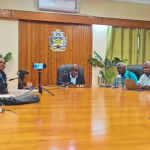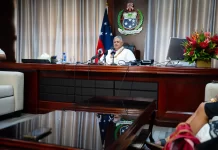




After burning the midnight oil in the run to the final hours of COP30 in Belem Brazil, delegates spent most of Wednesday and Thursday morning awaiting the Mutirao text.
Amongst them are Pacific delegations who have been working hard for the past two weeks, engaged in negotiation rooms and various COP spaces to advocate their national and regional priorities on ways to protect their communities already struggling with the lived realities of the climate crisis.
Delegates spent a good part of their day waiting, whether for guidance to emerge from the higher-level consultations, for Parties to report on progress achieved in informal informals, or for new texts to be released.
At the business end of COP, this is the reality. As the wait continues, and the anticipation builds in Belem ahead of the final day, we catch up with PSIDS lead negotiator on Just Transition (JT) track, Ms Talei Cavu, of Fiji.
Just transition is a framework for moving to a climate-neutral economy that ensures the process is as fair and inclusive as possible, creating decent work and protecting affected workers and communities.
It involves addressing social and economic impacts of climate and environmental policies by minimising negative consequences like unemployment and displacement, while maximising opportunities for all through measures like job creation, training, and social protection.
Question: Bula Talei, can you start by telling us why Just Transition is important for our Pacific communities?
Answer: In the national context it’s important because its purpose is to complement and support the work on mitigation, and adaptation. It ensures we do not overlook socioeconomic matters, particularly, the individuals and communities that maybe impacted by the transition.
It also determines whether the global transition away from fossil fuels will happen quickly enough, fairly enough, and with enough support for our islands to survive and thrive. JT provides a political space and technical mechanism to secure scaled up finance, technology access, skills, and energy system support to accelerate our shift towards renewables, strengthen energy security, reduce economic vulnerability, and safeguard livelihoods. At the COP, it strengthens the PSIDS mitigation priorities to ensure that 1.5-degree temperature goal remains the globe’s north-star.
QUESTION: At COP30, what is the most important issue for the Pacific when it comes to JT? What are our key asks?
We come here with a number of priorities, first amongst them is a decision that acknowledges the unique circumstances of SIDS and initiates a framework to develop a toolkit for open-market access to appropriate technologies in alignment with mitigation efforts (NDCs/LT-LEDS), supported by just transition measures, is essential for building SIDS resilience. We are also hoping for a decision on climate financing for just transition that should be understood in the context of climate justice and equity (grants>loans) as SIDS face distinct vulnerabilities that demand tailored responses to climate change impacts. SIDS continue to be on the frontlines of the climate crisis. We want a fair, fast, and 1.5⁰C aligned transition as it is not only a global imperative, it is a lifeline for SIDS.
QUESTION: Well, in the final hours of COP, how have negotiations been? Are we making progress? Or lack of?
ANSWER: There has been incremental progress with Parties converging on the broad structure of a mechanism and modes of work. The latest informal note keeps options in play rather than agreed text, like references to the 1.5 temperature goal, references to transition away from fossil fuels, etc.
PSIDS continue to work closely with AOSIS and G77+China group to safeguard the integrity of the mechanism, ensuring it is guarded by science, and preserve references to support equity, and the special circumstances of SIDS. Overall, meaningful convergence will depend on political guidance at the Ministerial level to prevent further dilution and ensure that the mechanism remains purposeful.
We have made our stance clear; we cannot support adoption of any outcome that does not explicitly advance a 1.5 aligned transition away from fossil fuels and backed by concrete means of implementation for developing countries, particularly SIDS. Without this clarity, there is no point in establishing a just transition mechanism.
QUESTION: What would it take for a good outcome for our Pacific countries?
ANSWER: A good outcome for PSIDS would be a clear, robust, operational mechanism that drives real progress on a 1.5 aligned global transition away from fossil fuels, while fully recognising the unique constraints and vulnerabilities of SIDS.
An acceptable outcome for SIDS would be to Rretain explicit language linking JT to deep, rapid, sustained emissions reductions and the transition away from fossil fuels. We want to strengthen enabling conditions, grant based finance, technology transfer, capacity building, to help SIDS overcome structural energy system barriers, as wel;l as protect our development space by keeping unilateral measures under the appropriate agenda item, not the Just Transition Work Programme (JTWP).
We also want to include a workplan that allows SIDS/PSIDS to meaningfully shape future dialogues and submissions and ensure the mechanism can contribute to real outcomes for Pacific communities, especially regarding energy security and resilience.
Without these elements, the mechanism becomes symbolic rather than functional, and the Pacific cannot support its adoption.