
By Nic Maclellan
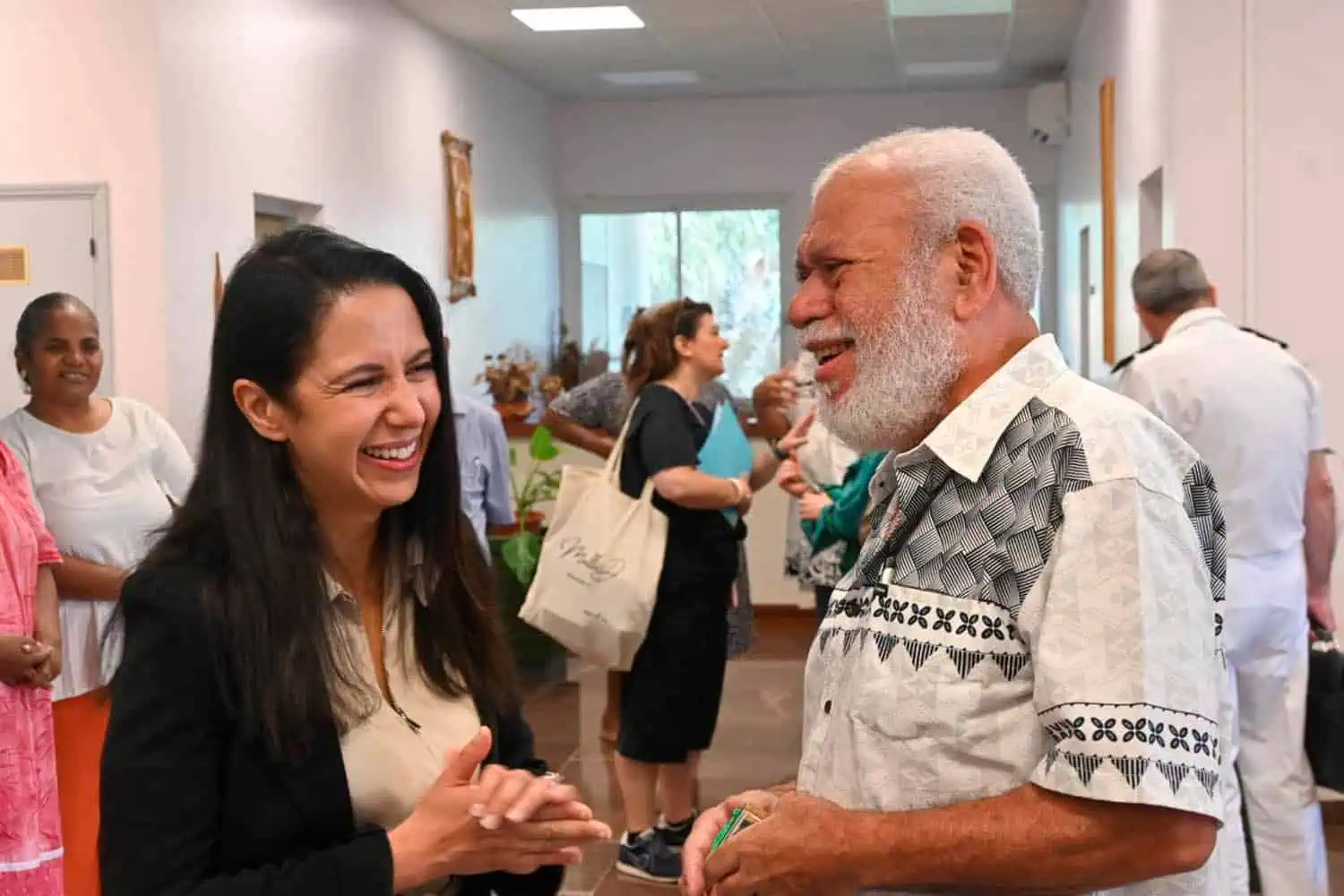
When France’s new Overseas Minister Naïma Moutchou toured New Caledonia last week, New Caledonians hoped that her visit would end uncertainty over political and economic reforms. Instead, Moutchou flew back to Paris leaving many unanswered questions.
Many people had hoped for firm commitments to help revive New Caledonia’s battered economy, and clarity around the timetable for a new political statute to replace the 1998 Noumea Accord, which has governed New Caledonia’s politics and economy for more than a quarter of a century.
Holding a series of meetings and closed-door discussions, Moutchou repeatedly told New Caledonians that, on her first visit as Overseas Minister, she was there to listen. But both supporters and opponents of independence were frustrated that she left without firm, clear commitments on fiscal reform and political change.
Since French President Emmanuel Macron was first elected in 2017, he has churned through seven Prime Ministers and 10 Overseas Minsters. Three French governments in Paris have collapsed in the last year. Macron wants to hang on until the next presidential elections, scheduled for May 2027, but there is no guarantee on the longevity of the current government in Paris, led by Prime Minster Sébastien Lecornu.
In September, Lecornu dumped Overseas Minister Manuel Valls from his cabinet, although Valls had spent months in New Caledonia crafting a series of compromises between supporters and opponents of independence. Coming to office, Prime Minister Lecornu pledged action on a new political statute, but Valls’ successor Naïma Moutchou has now floated major changes for New Caledonia – changes that raise questions about the legality and feasibility of this complex process.
New political statute
A key plank of the Lecornu government is to introduce a new political statute for New Caledonia, dubbed the Bougival Accord.
During negotiations at Bougival last July, former Overseas Minister Manuel Valls negotiated a draft text for the new statute. Valls proposed a timetable to introduce the draft agreement into law, involving a series of steps: the delay of New Caledonia’s provincial elections until mid-2026; the adoption of constitutional legislation by year’s end, with passage through the French National Assembly and Senate; then a joint sitting of both houses, known as the Congress of Versailles, to adopt the law. This would be then put to a referendum of New Caledonian voters in February 2026. If adopted, it would introduce changes to voting rights before the June 2026 provincial assembly elections.
Valls’ timetable was ambitious on paper, but has now been blown out of the water by repeated crises in both Paris and Noumea:
*At a Congress in August, the main independence coalition Front de Libération Nationale Kanak et Socialiste (FLNKS) formally rejected the draft Bougival text and continues to call for full and sovereign independence.
*On 8 September, French Prime Minister Francois Bayrou lost a confidence motion in the National Assembly, and was replaced the following day by Sébastien Lecornu, a close ally of President Emmanuel Macron.
*Lecornu’s first government lasted just 27 days, when he resigned just 14 hours after appointing a Council of Ministers.
*Four days later, Lecornu was re-appointed to the post by President Macron. The second Lecornu government is now filled with law-and-order hardliners, including Naïma Moutchou.
With the Lecornu government focussed on negotiations to finalise the French budget for 2026, it will be difficult to pass legislation on New Caledonia through both houses of parliament in Paris this year, according to Valls’ timetable.
So, as she left Noumea after a five-day visit, Naïma Moutchou launched a hand grenade, floating the idea of reversing the process to introduce the Bougival Accord. Instead of first seeking parliamentary approval for legislation before holding a referendum in New Caledonia, Moutchou suggested that the referendum could be held first, even before draft legislation went before the French parliament.
This immediately raised questions about the legality and practicality of this revised sequence.
Who would be eligible to vote in the referendum, given changes to voting rights and the definition of New Caledonian citizenship are a central – and controversial – element of the draft Bougival Accord? Would all French nationals in New Caledonia, or just long-term residents, be allowed to vote? Without new constitutional legislation, would the French State use old voting rolls, even though thousands of French voters have left New Caledonia over the last five years? What question would be posed in the referendum, if there is no agreement on the new legislative text? How will French parliamentarians have the opportunity to debate or amend the constitutional law in Paris, if a change has already been endorsed by voters?
Given a majority of New Caledonian political parties support the Bougival process (although differ over possible amendment of the text), this process seems designed to isolate the FLNKS. Moutchou’s latest proposal has confirmed the fears of FLNKS leaders, who have argued that the French State hopes to ram through the Bougival process without first crafting a consensus in New Caledonia (as President Macron tried last year with voting reforms, which triggered six months of conflict).
An FLNKS delegation met with the Overseas Minister twice last week, reaffirming “the goal of a final agreement is full and complete sovereignty.”
In a statement at week’s end, the FLNKS “clearly reiterated that the decolonisation process enshrined in the Noumea Accord, which has constitutional value, remains irreversible. Any discussion on the institutional future of the country must be in line with this commitment.” The independence coalition said “the so-called Bougival project cannot serve as a working draft because it goes against the decolonisation process. Any attempt to push it through without the FLNKS risks plunging the country into a situation of lasting instability.”
Split in the FLNKS
One outcome of last week’s meetings is a clear split between members of the FLNKS over the way forward.
At week’s end, leaders of the pro-independence Parti de Libération Kanak (Palika) held a press conference to announce the party will formally withdraw from the FLNKS. The two members of the UNI parliamentary group – Palika and UPM – suspended their involvement in the main independence coalition in August 2024, critical of the appointment of Christian Tein as FLNKS President, and the broadening of the coalition to include smaller parties.
At a press conference last Friday, Palika spokesperson Charles Washetine confirmed that the party will formally withdraw from the FLNKS after 41 years of involvement.
“What is happening within the FLNKS no longer represents us,” Washetine said.
“However, we have not given up on the political project of revolutionary and socialist independence for the country. We are pursuing the political option of independence through partnership, with negotiation as the central point. We have realised that the new FLNKS today is no longer following this strategy.”
Last week, Moutchou visited Palika president Paul Neaoutyine, who has also served as president of the Northern Province since 1999. Neaoutyine has long called for “independence in partnership” with France, while other FLNKS members like Union Calédonienne and Parti Travailliste want a clear timeline for a declaration of independence, albeit with a subsequent transitional period of partnership with Paris.
During meetings with Naïma Moutchou last week, Palika leaders proposed that there should be amendments to the draft text of the Bougival Accord (which the French government has already officially gazetted, despite the lack of consensus in New Caledonia). But some Palika members have recognised that the Bougival process will only work with the engagement of the largest independence party Union Calédonienne (UC), the central pillar of the FLNKS.
Palika spokesperson Jean-Pierre Djaïwé acknowledged: “If Union Calédonienne and the FLNKS have identified issues to clarify or modify, there is a possibility to do so.”
Debate between Palika and UC over the way forward has been underway for more than two decades, but the parties have managed to co-operate within the framework of the FLNKS. Last week’s rupture, however, has raised concern amongst some independence supporters that the French government is playing divide and conquer.
UC Secretary General Dominque Fochi stressed that for the FLNKS, “the direction does not change. Today’s FLNKS still carries the same message as in 1984. Now, we are waiting for concrete answers regarding the return of political prisoners. We haven’t had any since February. We want to see our comrades come back to the country.”
FLNKS members had called for long-delayed provincial elections to be held on 30 November, but the French parliament voted last month to push them back until mid-2026. If voters go to a referendum in February, they must vote again the following month for municipal council elections, scheduled in March 2026, and then again before 30 June for New Caledonia’s three provincial assemblies and Congress. These polls will all pose a test of the balance of forces within, as well as between, the pro-independence and pro-French blocs.
Economic woes
Ongoing uncertainty over the Bougival process and the election of new Assemblies and the Congress of New Caledonia have frustrated the business community, still reeling from last year’s crisis.
Arriving in the capital Noumea, Moutchou met local business leaders to discuss their concerns. Many wanted clarity about the French government’s pledges of financial assistance to New Caledonia, to recover from six months of clashes between French security forces and Kanak protestors. Last year, New Caledonia’s GDP dropped 13.5% compared to 2023, as many businesses closed their doors or sacked staff. Tourism numbers fell during the crisis, while the crucial nickel industry saw exports fall and the Koniambo smelter end production.
Business leaders had hoped that the newly appointed Overseas Minister would make firm commitments on the delivery of long-promised assistance from Paris. The business community wants the French government to extend current employment wage subsidies until mid-2026 and underpin insurance for Small and Medium Enterprises hit by last year’s riots. Many New Caledonian politicians have also been urging Paris to convert a current 1-billion-euro loan into a grant, to avoid further debt burden.
Compared to 2023, last year’s tax revenues fell by 54.5 billion Pacific francs ($AUD804 million), and there may be a similar shortfall this year. Despite the unprecedented economic and social crisis, the French government is demanding further belt-tightening by the Government and Congress of New Caledonia. Already the Southern Provincial Assembly, led by anti-independence politician Sonia Backès, has slashed school lunch programs and increased public transport fees, hitting vulnerable families, especially Kanak, Wallisians, and other islanders.
“But Paris wants more,” Christophe Dantieux, head of the Confederation of Small and Medium Enterprises, told journalists.
“There have already been quite a few efforts, particularly in New Caledonia’s 2025 budget, with a 15 per cent reduction in public spending. However, for the French State, that is not enough. It is asking for a bit more, and that is precisely the difficulty we are facing.”
New Caledonia’s newly appointed budget minister Christopher Gygès echoed employer concerns: “The meeting with the economic players on Monday evening was clearly very insufficient in terms of announcements. I can only hope that there will be others during the week in terms of support.”
Moutchou however avoided firm commitments, given the current political and financial crisis engulfing the French government. With President Macron losing support in opinion polls, his ally Prime Minister Lecornu is desperately trying to finalise an austerity budget, and – lacking a governing majority in the French legislature – is hoping to stave off a further dissolution of the National Assembly and new elections.
Earlier this month, looking for budget cuts that won’t lose more domestic support, Lecornu proposed to reduce tax relief granted to companies for their investments in France’s overseas colonies. But after fierce protests from overseas deputies, his proposal was rejected in the National Assembly, by a vote of 250-1.
Between now and New Caledonia’s proposed referendum in February, there is no guarantee that the second Lecornu government will remain in power in France. Given this uncertainty, there are still many questions about whether New Caledonia can maintain a peaceful process of dialogue, or whether it will return to the conflict that wracked the country after May 2024. Time is short, and there are no clear answers about whether Paris will – once again – push through political changes against the will of many Kanak and other supporters of independence.