



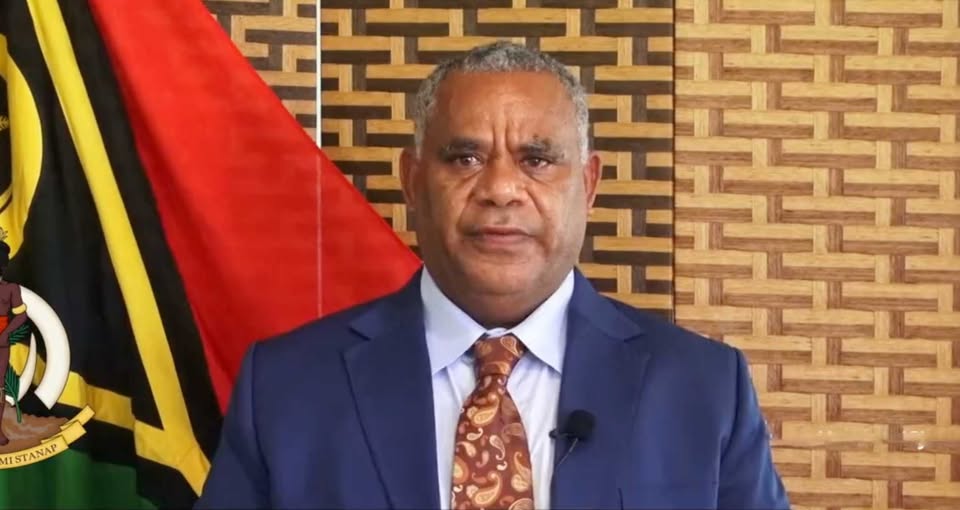
Vanuatu Prime Minister Jotham Napat told Parliament Friday that the amendment to the Citizenship Act aims to make the programme fully independent and free from political influence.
He said many political leaders have interfered in the decision-making of the Citizenship Office, and the new amendment seeks to address that issue.
Speaking during the second extraordinary sitting, Prime Minister Napat said, “While government maintains overall policy direction, the citizenship programme must be independent. Recently, some members of this honourable house have threatened staff of the Citizenship Programme, and that’s why we want this amendment — to ensure no political interference.”
The Citizenship Amendment Act No. of 2025 passed with 36 votes in favour and 10 abstentions, all from the Opposition.
Opposition Leader Ishmael Kalsakau said they support the idea of independence for the Citizenship Office but believe there are other areas that allows room for a Prime Minister to influence decisions.
“The intention is good,” he said, “but there are still areas where political control remains. If we want real independence, the law must be clear and complete.”
Responding, Prime Minister Napat said the government has taken note of the discussions and will continue to strengthen other areas of the programme.
Member of Parliament for Malo/Aore, Allan Liki, a former Secretary General of the Citizenship Commission, also said there has been too much political interference in the past.
He agreed the amendment is a good step but added that “the policy itself must also be completed to make the program more effective.”
The Citizenship Programme is one of Vanuatu’s biggest revenue sources. In the first eight months of this year alone, it collected around 14 billion vatu (US$115,221,639), surpassing the annual target of 7 billion vatu (US$57,762,271).
Under the programme, there are 11 Capital Investment Immigration Plan Agents and 55 Development Support Programme Agents.
Prime Minister Napat said the strong revenue performance shows the programme’s success and that the new amendments will help increase transparency, ensure fairness, and protect Vanuatu’s reputation by preventing people with criminal records or those on Interpol Red Alerts from gaining citizenship.
All agents assisting with applications will now be required to register and follow stricter procedures.
Meanwhile, Prime Minister Jotham Napat continues to question the progress and credibility of investments under the Capital Investment Immigration Program (CIIP).
He said while there has been a lot of talk about CIIP-funded developments, the government has yet to see real results from most of these projects.
Napat made these remarks during the groundbreaking of the New Town Subdivision Project on Efate, developed by Future Fund Company, which is the first actual investment under the CIIP programme.
He questioned why other CIIP investments that were announced have not yet taken shape, despite the large amounts of money reportedly involved.
“Under the CIIP programme, one of the main components is investment. But since the start of the programme, we haven’t seen any of these investments. We only hear about them; we don’t see them. Out of all the CIIP agents, this is the first one we’ve seen actually delivering.
This raises a lot of questions: where do these funds go? These funds are supposed to be for the government. Some claim to have invested in kava, but we are still looking for the kava. Others say they invested in cocoa and coffee, but we don’t see anything. This raises serious questions about the credibility of the CIIP programme,” said PM Napat.
A recent VBTC report shows that there are over 20 agents managing the Citizenship Program under CIIP.