
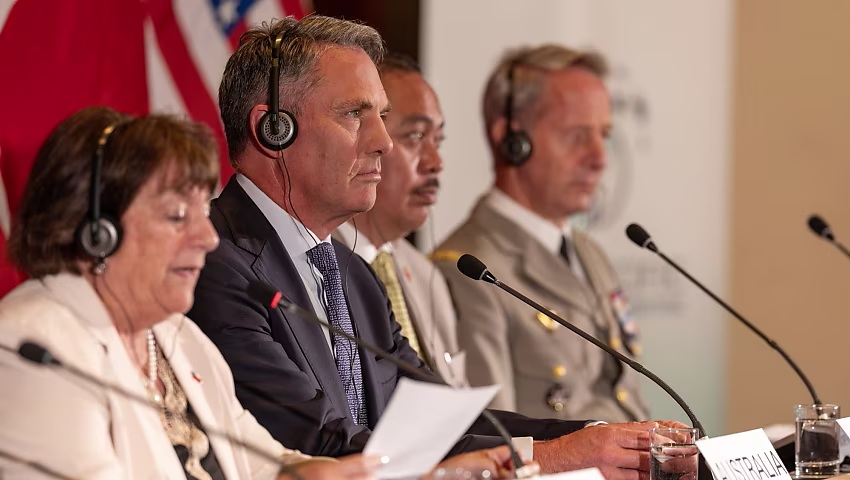
Australian deputy Prime Minister Richard Marles has been queried about the clashes between the People’s Republic of China and United States of America in the Indo-Pacific, last week.
Minister for Defence Marles was in Chile for the South Pacific Defence Ministers’ Meeting (SPPDM) from 22 to 24 October.
Regional Defence ministers gathered for the conference to discuss defence and security cooperation in the South Pacific. Members included Australia, Chile, the French Republic, the Kingdom of Tonga, New Zealand, Papua New Guinea, and Fiji; while officials from Japan, the United Kingdom and the United States attended as observers.
“We observe that the Pacific is a place of growing geostrategic contest,” Deputy Prime Minister Marles said, without directly referencing the People’s Republic of China or a recent Australian Defence Force altercation with the People’s Liberation Army fighter jets over the South China Sea.
“In seeking to understand that and appropriately respond and react to it, all of the members of SPDMM and all of the observers who are here at SPDMM as well; the UK, Japan and the United States, all of us share values as democracies, as countries which respect freedom of speech, and which seek to uphold a rules‑based order.
“And a rules‑based order is very much in the national interest of countries of our size. It gives us agency. In a world which is only about power and might, it is hard for smaller countries to be able to deal with the issues around them.
“But in a world where differences between countries are determined by rule of law, by international law, that’s a world in which we have agency. And so it is from that perspective that we seek to work together as a Pacific family to build capability, and through a range of the measures that we’ve been talking about over the last three days, we are taking really significant steps forward in terms of building that capability.
“It is about ensuring that we are upholding the rules‑based order within the Pacific, and we are meeting the aspiration which was articulated at the Pacific Islands Forum in Solomon Islands this year, that the Pacific be an ocean of peace,” said Marles.
Chilean Minister of National Defence, Adriana Delpiano confirmed several topics of discussion during the conference, such as the proposal of Chile to establish a joint military exercise.
“The authorities welcomed… a biennial military exercise in the territorial waters of the country, very likely in Easter Island, once we have discussed these with relevant authorities and the Island,” according to Delpiano.
“This is the result and reflects very clearly the way we are working with our neighbours in the Pacific to improve security of the countries.
“Few maritime territories are as vast as the one that goes from Australia to Chile on the south side of the Pacific, to the north from Ecuador to Antarctica. All who are here; we are members of countries which represent small islands but also share the SPDMM history.
“Over these days, we’ve faced the new trends in terms of security, and we underscore the importance of cooperation among the military forces to guarantee a safe, resilient and peaceful region. We also renewed the commitment for cooperation for climate change disasters, the growing demand of humanitarian assistance, and the need to face non‑traditional maritime threats, such as transnational organised crime.
In terms of interoperability, we assessed the progress made by the Pacific Response Group during the first year, and the second phase was approved, which will apply the new host, New Zealand, from 2026,” she said.