Australia and Papua New Guinea have reaffirmed their deepening defence alliance, with both countries committing to expand training, recruitment, and military cooperation while maintaining respect for each nation’s sovereignty and national priorities.
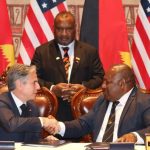
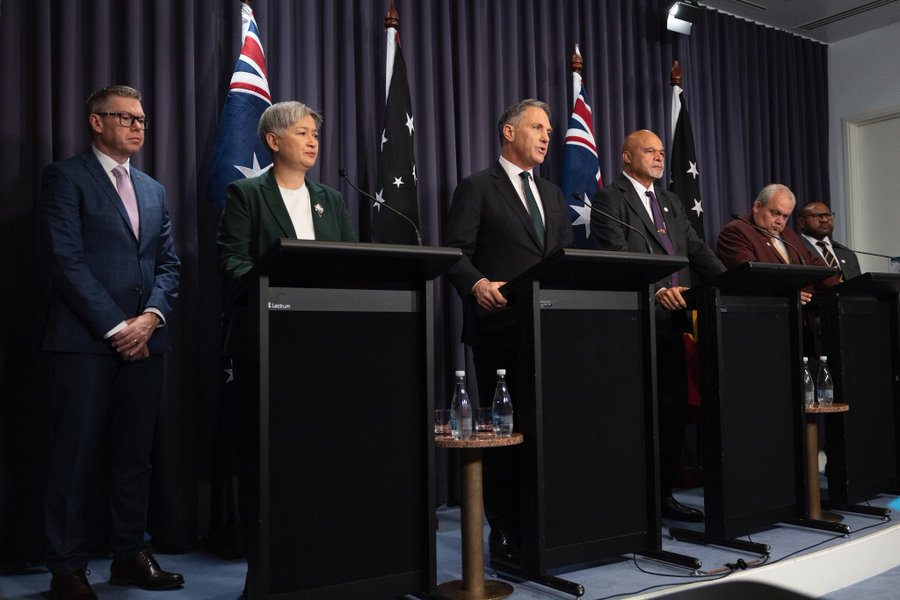
At a joint press conference following the PNG–Australia Ministerial Forum in Canberra, Australian acting Prime Minister and Defence Minister Richard Marles, PNG Defence Minister Dr Billy Joseph, and PNG deputy Prime Minister John Rosso addressed key questions on defence, training, and bilateral relations.
Marles said discussions on Australia’s ongoing budget support to PNG would continue during the forum but confirmed no new announcement was being made.
“Well perhaps to start with, on budget support. I mean, actually, in the history of our two countries, since independence, there’s been various points along the way where there has been budget support provided by the Australian Government to PNG, as you’re aware,” Marles said.
“We will talk about this in the context of the Ministerial Forum that we have later this afternoon. We’re not making an announcement now in respect of that. But we want to be the best partner we can be to PNG, and however that is most practically done is how we will do it.”
On the defence front, Dr Joseph said the alliance is focused on building PNG’s capability across all military sectors — land, sea, and air.
“As allies, PNG wants to be an important partner to Australia and building defence capability is something that we really wanted, and that’s in article five of the Defence Treaty,” Joseph said.
“And so whatever shape or form it may be, as long as it builds defence capability, including air capability, like you said, we would appreciate and will work together with our Australian counterparts, especially DPM Marles to work on that and our two teams, defence teams, have been working very closely on what would be the choice, or the capability in detail. Whether that be aviation, in the naval, well as in the army, including the guns that you’ve mentioned. We will work on that as we go through.”
Joseph dismissed suggestions that PNG expected Australia to fund operational costs such as catering, saying those were domestic responsibilities.
“With the catering, I think that has been part of our defence budget. We’ve managed that from time to time, and that’s not something that we would be expecting Australia or somebody else to pay for us. It’s part of our budget and we do that every year,” he said.
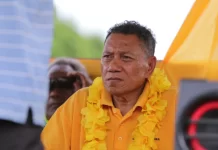
PNG deputy Prime Minister Rosso said PNG’s interest in building air capability also tied into national development goals.
“You should look further at that; it’s more to do with the training, enhancing capability and training,” Rosso said.
“And the good thing that happens is that previously, after 1925 we had a capable air squadron and now we’re looking at the relationship, building up the air squadron again. It’s to enhance, in a rural capacity; delivery, agriculture, produce, that sort of infrastructure building and training pilots that further on, they move on to our national airline, and it helps enhance our national airline by providing good training for pilots.”
The conversation also turned to Australia’s plan to recruit up to 10,000 Papua New Guineans into the Australian Defence Force (ADF), a key element of the new alliance.
Marles said the initiative would be designed to benefit both nations and would include strong training components to ensure it does not undermine PNG’s own military growth.
“Perhaps, to start with the issue of recruitment, we see recruitment of public Papua New Guineans into the Australian Defence Force as a real opportunity, actually, for the ADF,” Marles said.
“I know that this is a matter that I’ve discussed with both John and with Billy, and from the PNG side, there seems to be a sense that there’s a real opportunity here in terms of providing opportunities for the younger generation in PNG. But you ask a really good question, and as we started talking about making sure that this is a program that works for both PNG and Australia, and in terms of PNG’s capability – military capability as well, is really critical.”
He said training will be at the heart of the partnership.
“As we have discussed this, at the heart of the answer to that is training. This will work if we are investing in the training of people before they enter the defence forces, and obviously all the training that comes once you do enter the defence forces. So central to our thinking about how we make this work is actually investing in training capabilities in PNG,” Marles said.
Rosso said the recruitment and training initiative would bring broad economic and social benefits to PNG.
“As you pointed out, the training and enhancement, we should look at a different picture also. While there’s 10,000 Papua New Guineans going to be serving the Australian forces, our side whilst we do that, it also enhances training,” Rosso said.
“You look at the Fiji and UK sort of relationship, the money that’s remitted back to the country of hosts, and that helps build up the country’s development capacity. It also enhances– it’s not just infantrymen, we’re training medics, we’re training signal people, we’re training other people in different aspects. And that comes back to boost our country and build up the capacity of our people to help Papua New Guinea move further forward.”
Rosso also confirmed that China had raised questions about the Pukpuk Treaty during his recent visit to Beijing but said the discussions were cordial and did not affect PNG’s sovereignty.
“Yes, we did discuss it. They raised it. But clearly our plan, and they respect our sovereignty, China has always been a big partner of ours, too, similar to Australia,” he said.
“They’ve been a great partner. We have a relationship with them in trade, investment, and that has grown and strengthened from strength to strength, so doesn’t in any way impeach on our sovereignty and on additions that we’ve made with the Treaty with Australia.”
Dr Joseph reaffirmed PNG’s plan to expand its national defence force to 10,000 personnel — 7,000 active and 3,000 reserve — but clarified that those joining the ADF would not be part of the PNG Defence Force.
“Internally, the PNGDF has a plan to have up to 10,000 soldiers – 7,000 active force and 3,000 reserve force. And so the Papua New Guineans who are coming to serve through the program to join the ADF will never be part of PNGDF,” Joseph said.
“They will be members of the ADF. So there will be no poaching going on from PNGDF and PNGDF will maintain its sovereignty and constitutional obligations under section 202 of our Constitution. Therefore it is not confused in that those joining the ADF won’t be members of PNGDF. They’ll be just ordinary Papua New Guineans who will come and join the ADF.”
The leaders reaffirmed that the new alliance would strengthen security, enhance training opportunities, and expand regional cooperation — marking a new phase in the long-standing partnership between Australia and Papua New Guinea.