



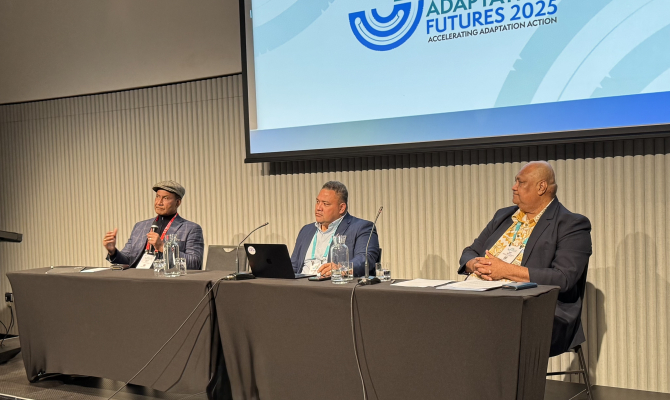
Tuvalu’s Minister of Home Affairs, Climate Change and Environment delivered a powerful message during a guest lecture hosted by the Macmillan Brown Centre for Pacific Studies at the Adaptation Futures Conference, affirming that Tuvaluans will not abandon their homeland in the face of rising seas and climate threats.
Dr Maina Talia was joined by the Director General of the Secretariat of the Pacific Regional Environment Programme, Sefanaia Nawadra, and was asked by Professor Steven Ratuva, Pro Vice-Chancellor of the University of Canterbury and Director of the Centre for Pacific Studies on his thoughts on climate mobility and climate-induced migration and relocation, noting that Tuvalu has entered the Falepili Agreement with the Government of Australia which allows Tuvaluans to relocate to Australia.
Talia’s answer was firm. “We will not leave our island.”
“I was born and raised in the island, and I still live in the island. It’s emotional and difficult to discuss these issues because in the Pacific, we have a special bond and attachment to the land,” Talia said.
This bond to the land can be found in most Pacific island countries and cultures, where it is common practice that when a child is born, the umbilical cord or the placenta is buried in the land, so that they always know where they belong.
“The Tuvalu Government has always maintained that migration is a definite no, but it’s a matter of choice,” Talia said.
The Minister made note of the recent discourse surround climate-induced migration, stating that there is a new breed of scholars who are saying that because the initial settlers of the Pacific migrated from South-East Asia, it is also possible for Tuvaluans living in the coral atoll nation to migrate to other countries to escape the impacts of climate change.
“It’s easy for those living outside of Tuvalu to look at us and say, ‘Yes, it can be done. It is possible for them to move.’ We should have the courage to stand up and say no,” Talia stated.
“They talk about living with dignity, moving with dignity. To me, there is no dignity in being removed from your island, from your home, to go live somewhere else because the actions of others have rendered your home unlivable,” he added.
Talia reflected on a country-wide consultations which resulted in an outcome document on migration in Tuvalu, attended by people from all walks of society. Their answer to the migration was a unanimous and resounding no – they do not want to move.
However, people are still given the choice to take advantage of opportunities such as the Falepili Agreement. Tuvaluans are still given the freedom to choose to move away in search of better opportunities, education and healthcare in Australia.
Talia said the issue of migration is not an easy one to discuss because it’s not theoretical. It is an issue that directly affects people whose contributions to the climate crisis are 0.00001 percent, next to nothing, and yet are being forced to move away from their homes.
“Our values, who we are as people, are all tied to our land, and we will not leave,” Talia said firmly.
When asked of the role that regional organisations like SPREP play in facilitating climate migration, Director General Nawadra said that this is not an area that is within SPREP’s mandate.
“SPREP works on issues that are requested by our 21 Pacific Island Member countries and territories, and all of them are firm on their answer to the climate migration issue. None of them want to leave their islands, and so this is not a priority for them.”
“What we are doing is helping our countries with their climate change adaptation and mitigation efforts, and when they are no longer able to adapt, assisting them in getting compensated for loss and damage. They will fight as long as they can to stay on their islands, and so will we,” Director General Nawadra concluded.
The Adaptation Futures Conference was held from 13 -16 October in Christchurch, New Zealand.