


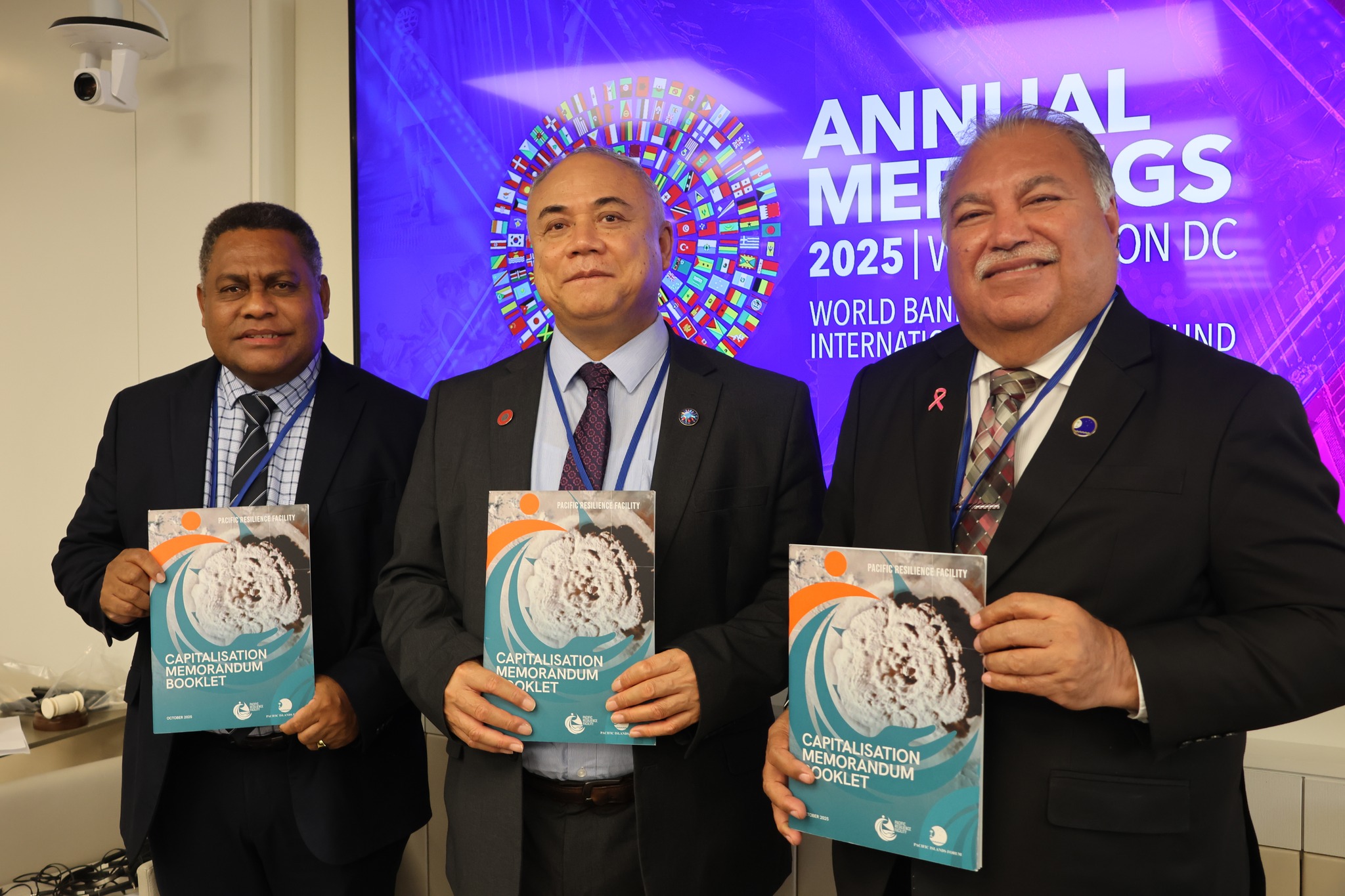
The establishment of the Pacific Resilience Facility (PRF) represents a defining moment for the Blue Pacific region, as Forum Leaders and international partners gathered this week at the International Monetary Fund (IMF) headquarters for the PRF Partners Roundtable Talanoa.
Pacific Islands Forum Secretary General, Baron Waqa, welcomed leaders and partners by reflecting on the founding principles of the IMF and linking it to the Pacific’s own resilience journey.
“As we gather here for the first Pacific Resilience Facility Talanoa between our Forum Members and Partners, I am reminded of the fundamental principles upon which the IMF was founded — to reconstruct from the ravages of war and economic depression, foster global monetary cooperation, secure financial stability and facilitate sustainable development,” Waqa said.
He described the PRF as a bold, Pacific-driven response to the region’s most pressing existential threats.
“The creation of the Pacific Resilience Facility represents our clear and mutual determination and commitment to fortify our Blue Pacific region from the grave, irreversible and existential threats of climate change,” he said.
“It is guided by our 2050 vision for a resilient Blue Pacific and rooted in our collective and united desire to survive and thrive in a 1.5-degree world.”
Born from frustration over the region’s limited access to global climate finance, the PRF was first envisioned over a decade ago. Today, its establishment comes at a time when “multilateralism is being challenged and reshaped by a changing world,” Waqa said.
He emphasised that the PRF is “for the Pacific, by the Pacific”, to establish the first International Financial Institution to be collectively owned by Pacific governments.
“The PRF represents what a responsive and inclusive global financial system will need to consider emerging from adversity with a genuine transformation mandate mandate that recognises the unique vulnerabilities and development aspirations of Forum Member Countries and leaves no one behind,” he said.
“This is the essence of the test of multilateralism, whether it works for those who need it the most.”
Waqa highlighted the stark inequities in the global financial system: “Never before has so much wealth and capital been created by the world, but so unevenly distributed and scarcely available for those who not only need it the most, but who also need it urgently as we battle a changing climate we cannot control.”
He said the Talanoa at the IMF demonstrated the Pacific’s political resolve and collective solidarity to ensure that voices of Pacific communities are heard, and priorities are reflected in the ongoing review of the global financial architecture as the world considers the “next iteration of Bretton Woods.”
In a show of regional unity, Waqa announced that Forum Leaders have signed the Agreement to Establish the PRF during the 54th Pacific Islands Forum Leaders Meeting in Solomon Islands. Two weeks earlier, Solomon Islands Prime Minister and Forum Chair, Jeremiah Manele, launched the PRF Capitalisation Memorandum on the sidelines of the 80th United Nations General Assembly.

To date, international partners have contributed and pledged a total of US$166 million to the Facility.
“We warmly welcome the continued support of the international community for this first Pacific-led, owned, and managed financing facility dedicated to climate and disaster resilience for communities in our region,” Waqa said.
As the depository of the PRF Treaty, Waqa also confirmed the receipt of the first two instruments of ratification, from the Kingdom of Tonga and the Government of Nauru.
“I assure you of our full support and attention for the Treaty’s safe passage to ratification, as we work with our members to bring it into force,” he said.
Looking ahead, Waqa called for partnerships that go beyond the status quo to fully realise the vision of the PRF.
“It will require transformative partnerships that go beyond status quo to establish the PRF together as a historical and catalytic institution for communities at the front line of climate change.
“The PRF will be that beacon of hope for our present and future generations,” he said.