

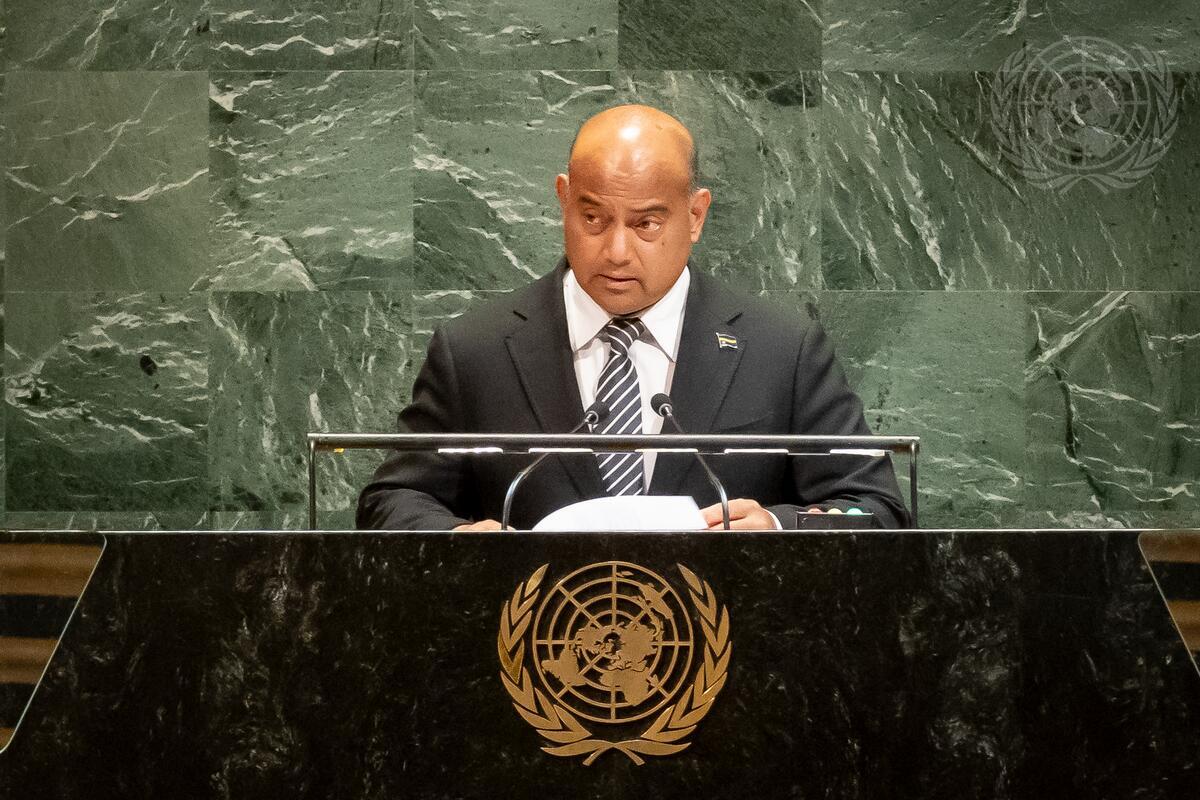
Nauru President David Adeang has told world leaders at the 80th United Nations General Assembly (UNGA80) that his country, though small, carries a strong voice for peace, resilience, and fairness in global governance.
“It is an honour to address this Assembly on behalf of the people and government of the Republic of Nauru — a small island nation committed to peace, prosperity, and a sustainable future for all,” Adeang said.
“It is also a great privilege to speak as the first leader from the Pacific at this 80th session.”
The Nauru leader warned that global divisions were deepening and urged countries to embrace dialogue and solidarity.
“We gather at a time when the world faces unprecedented challenges to peace and security,” he said. “Nauru stands firmly against war and conflict, believing that dialogue and diplomacy must always prevail over division.”
He reminded delegates that the principles of the UN Charter must remain at the heart of international cooperation.
“Nauru may not have military might, but we have moral authority earned through our commitment to peaceful coexistence and multilateral solutions,” Adeang stressed.
“We call upon all nations to choose unity over discord, cooperation over conflict and shared prosperity as the foundation for addressing our common challenges.”
Adeang outlined his country’s economic vision, stressing that small island developing states (SIDS) like Nauru must break free from dependency.
“Nauru’s strategy is simple: invest in our people—they are our greatest asset and the foundation of our future,” he said.
He highlighted the role of partnerships in supporting Nauru’s progress, pointing to Australia as a long-standing partner.
“We are deeply grateful to Australia, whose steadfast support goes beyond diplomacy and partnership,” Adeang said. “As we say in Nauru, Ata Amin Bwini — which means, we are family.”
He also reaffirmed Nauru’s ties with China.
“We value our productive relationship with the People’s Republic of China and reaffirm our commitment to the One-China Principle,” Adeang said, noting that Chinese cooperation had created meaningful opportunities for infrastructure and development.
Adeang stressed that Nauru’s approach is about creating long-term resilience.
“Our economic resilience strategy is centred around the Intergenerational Trust Fund, the Economic and Climate Resilience Citizenship Programme, the Command Ridge Virtual Asset Authority, Deep Seabed Mineral Resources, and our pursuit of Egmont Group membership,” he said.
“These initiatives diversify our economy, create transparent revenue streams, and ensure that today’s progress benefits those yet to come.”
Adeang pressed for faster implementation of the Multidimensional Vulnerability Index (MVI), which measures the unique challenges faced by SIDS.
“By conventional measures, Nauru’s national income suggests we have surpassed certain thresholds. But income alone fails to capture our fragility,” he said.
He argued the MVI should determine development support and access to concessional finance. “Let us not let a statistic determine who gets left behind,” Adeang told the Assembly.
Turning to climate change, Adeang issued a blunt warning.
“Climate change is not just an environmental crisis, it is a direct threat to our peace, our security, and the very survival of our nation,” he said.
He highlighted Nauru’s Higher Ground Initiative (HGI) and the Pacific Resilience Facility (PRF) as critical projects.
“The PRF is not charity; it is a sound investment in stability, security, and sustainability,” Adeang said.
“Let us move beyond pledges and deliver real protection and hope for our people, the Pacific, and the generations to come.”
Adeang also defended Nauru’s role in deep seabed mineral exploration, saying it was about balancing environmental responsibility with economic opportunity.
“The choice before us is clear: either we source these critical minerals responsibly through strong regulatory frameworks, or we continue to give in to delay,” he said.
“When Nauru invoked the two-year rule, we did so in good faith, expecting the multilateral system to fulfill its treaty obligations. Yet, negotiations remain polarised, and the timely adoption of regulations appears increasingly elusive.”
He welcomed U.S engagement on seabed minerals.
“For Nauru, seabed minerals represent more than economic diversification—they are a pathway to resilience and a chance to contribute to global solutions,” Adeang said.
Adeang called on the UN to embed the “Special Circumstances of SIDS” into its decision-making frameworks.
He also called for an end to unilateral economic measures that increase vulnerabilities.
“Standing with vulnerable nations, Nauru calls on the international community to end unilateral economic measures that deepen vulnerabilities and limit development opportunities,” he said, citing long-standing restrictions affecting Cuba.
Adeang closed his address with an appeal for global unity.
“History will not judge us by our words, but by the future we build — by whether we choose unity over division, peace over conflict, and shared humanity over selfishness,” he said.
“The theme before us — ‘Better Together’ — calls on us to protect the vulnerable, build resilient economies, and safeguard the planet for those who will follow. On behalf of the Republic of Nauru, I reaffirm our unwavering commitment to the United Nations and the vision of a just, peaceful, and sustainable world,” said President Adeang.