

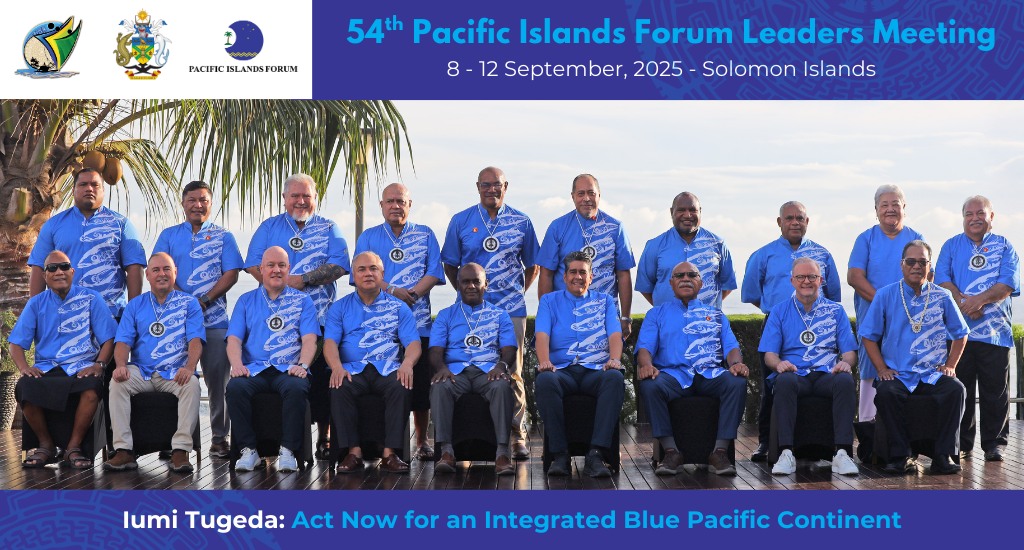
Forum Leaders have endorsed moves to sharpen engagement with the United States and strengthen regional solidarity in the face of climate threats, geopolitical competition, and economic fragility.
In their communiqué issued at the conclusion of the Forum Leaders Meeting in Honiara last week, Leaders said they had “noted the Report on the Implications of U.S Policy Shifts on the Pacific Islands and CROP Agencies endorsed by Forum Troika Leaders, including its recommendation to develop a unified, targeted advocacy agenda on engagement with the United States of America (U.S) through a Special Envoy to be appointed by Troika, in consultation with Forum Leaders, on a needs basis to strengthen Pacific engagement and coordination with the U.S.”
The decision signals a bid to coordinate regional dealings with Washington more effectively, as the U.S rolls out new commitments across security, health, and economic sectors in the Pacific.
Reflecting on the region’s wider challenges, Leaders “recognised that the region’s strategic landscape in 2025 was one of both challenge and opportunity.
The convergence of climate impacts, geopolitical competition, economic fragility, and social pressures highlighted the importance of strengthened regionalism.
They stressed the need for strong Forum governance and reiterated the Troika’s role in anchoring political settlements.
“In an increasingly complex strategic landscape, Leaders emphasised the value of strengthened Forum governance, including the ongoing advisory role of the Pacific Islands Forum Troika, to anchor deliberations and member-led political settlements,” said the Communique.
Leaders also reaffirmed regional solidarity and pushed for deeper economic cooperation.
“Leaders reaffirmed inclusivity and solidarity in guiding the work of the Forum family. Leaders reflected on and further reaffirmed the importance of regionally driven economic development and encouraged deeper regional integration, including in trade, fisheries development, labour mobility, digital connectivity and sectoral cooperation where relevant, while continuing to ensure that partnerships are aligned to Forum decisions and the 2050 Strategy for the Blue Pacific Continent (2050 Strategy),” the communique said.
The communiqué highlighted engagement with stakeholders across society, with Leaders welcoming dialogue with regional organisations, business and civil groups.
“Leaders reflected on their dialogues with regional stakeholders, including the Heads of CROP, representatives from the private sector, civil society, and Associate Members. Leaders welcomed the robust exchange of views on key development, political and social issues and agreed to refer these issues to the relevant Forum processes for oversight and advice to the Forum Officials Committee (FOC), and to be considered by Leaders in 2026.”
Anchoring their discussions on long-term sustainability, Leaders reaffirmed the 2050 Strategy as the region’s shared vision.
“Anchored in solidarity and sustainable development, Leaders reaffirmed the 2050 Strategy as the region’s collective vision. Its Implementation Plan sets the framework for collective action, ensuring that national priorities are advanced regionally, where necessary, to deliver the greatest impact,” said the communique.
They also endorsed new progress updates under the strategy.
“In considering the progress update on implementation, Leaders endorsed the Executive Summary of the 2050 Strategy Regional Collective Actions (RCA) Report which highlighted the practical initiatives already underway that give effect to the 2050 vision.”
The communiqué positions the Forum to navigate a turbulent period, reinforcing regional unity and sharpening collective diplomacy with major powers.