

By Pita Ligaiula in Honiara, Solomon Islands
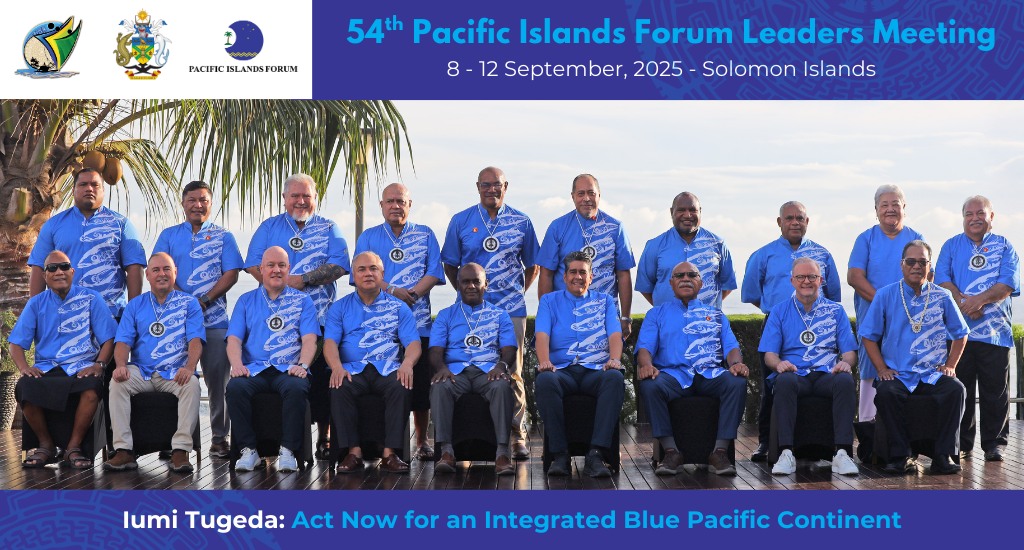
Pacific Islands Forum Leaders have endorsed a new policy to govern engagement with external partners, aiming to strengthen Pacific ownership and ensure all partnerships align with the 2050 Strategy for the Blue Pacific Continent.
In their communiqué, Leaders reaffirmed the importance of partnerships but stressed that they must be “genuine, durable, and accountable, and which strengthen Pacific leadership, voice, and engagement to ensure recognition and alignment with Pacific cultures, values, priorities, and collective interests.”
The new Forum Leaders Policy on Partnerships replaces the old Dialogue Partner and Observer classifications, introducing a dual framework: Strategic Partners, with broad and long-term cooperation, and Sectoral Partners, with targeted support in specific areas.
A transitional stream will cover applicants and partners shifting between categories.
Leaders said the policy responds to the “growing number and diversity of Dialogue Partners and Observers” and the need to safeguard the primacy of Pacific voices in regional decision-making.
Under the new system, all partners must meet clear criteria, including long-term commitment to the Pacific, alignment with Forum priorities, and transparency in declaring political, economic, or strategic interests. Applications will be formally assessed and subject to political discretion by Leaders.
Once admitted, partners will be required to develop a Pacific Action Commitment and Engagement (PACE) Plan, outlining how their support contributes to regional priorities under the 2050 Strategy.
Strategic Partners will continue to access annual Leaders’ dialogues, while Sectoral Partners will be limited to technical and thematic discussions relevant to their contributions.
Leaders also agreed to tighter accountability, with annual reporting by partners and a Quadrennial Assessment to review engagement, delivery, and alignment. Partners that fail to meet obligations risk being shifted between streams, suspended, or having their status revoked.
The communiqué said the new policy “anchors partner engagement with the Pacific Islands Forum at a strategic and enduring level, reinforcing both continuity and alignment with collective priorities.”
The Forum’s partnership model has been central to Pacific diplomacy since the 1980s.
The Dialogue Partner mechanism was set up in 1989, initially with a small group of partners, to give Pacific leaders direct access to major powers and donors. Over time, the list expanded to more than 20, including traditional allies like Australia, New Zealand, Japan, and the United States, as well as new players such as China, the European Union, and India.
These sessions, often held on the sidelines of the annual Leaders’ Meeting, became high-profile events. But as the number of partners grew, so did the complexity. What started as focused conversations evolved into long, crowded meetings where competing agendas often overshadowed Pacific priorities.
Leaders have grown increasingly wary of external influence overwhelming their agenda.
Climate change was one major source of friction.
Pacific countries, facing rising seas and stronger storms, demanded stronger commitments, particularly from Australia and the United States, only to be met with pushback in earlier meetings. At times, partner resistance to Pacific positions on coal use and emissions targets left leaders frustrated.
Geopolitical competition has added further tension.
The growing rivalry between China and the United States spilled into the Forum space, with both nations pressing for influence. In 2022, Beijing sought a sweeping regional security deal, sparking concerns among Forum members that such moves bypassed established mechanisms and undermined Pacific unity.
By tightening the rules, Leaders want to avoid the Forum becoming a battleground for external powers.
The new framework sets clearer boundaries- partners are welcome, but engagement must respect Pacific sovereignty, align with collective decisions, and deliver on the priorities of the 2050 Strategy.
With the new policy, the Forum is signalling that while partnerships remain vital, they will be on Pacific terms.