



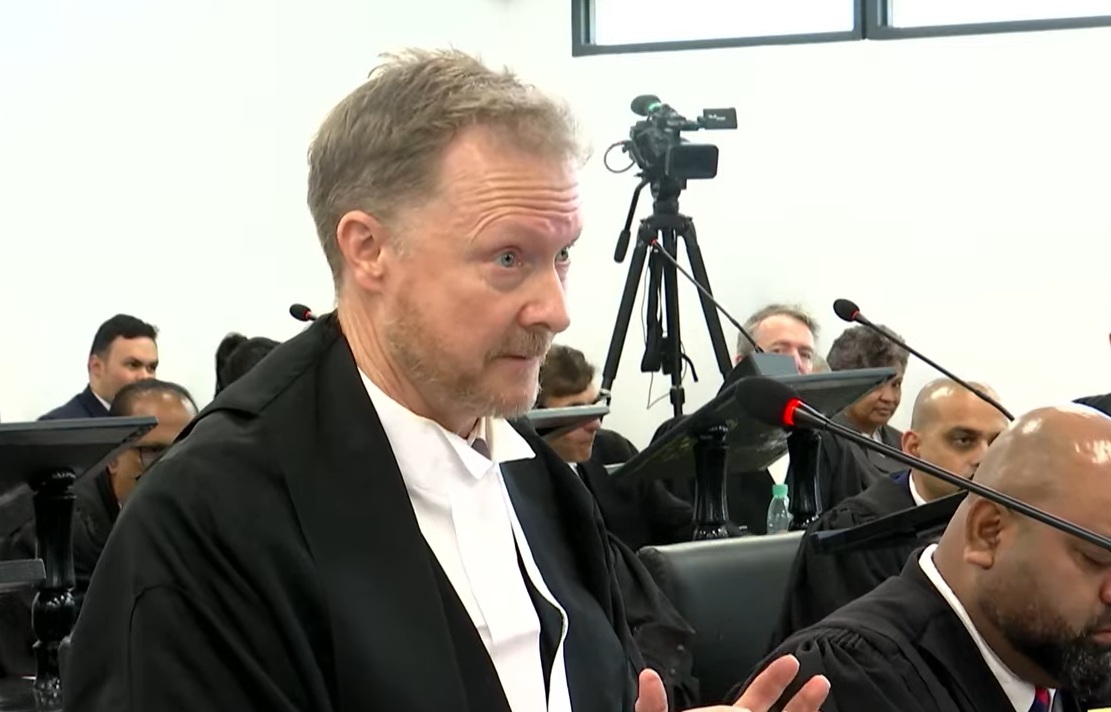
Prominent New Zealand constitutional lawyer Andrew Butler, appearing as amicus curiae in the Supreme Court proceedings, has described Fiji’s constitutional amendment process as presenting a “conundrum,”.
In his oral submissions this morning, he acknowledged the complexity and rigidity of Fiji’s 2013 Constitution.
“What the parties and the court have been exploring is what I am referring to as a conundrum. Others may call it a dilemma,” he said.
He elaborated that the entrenched amendment provisions make Fiji’s constitution among the “most difficult to alter” but stressed that this fact alone should not be seen as problematic.
“There are many constitutions that are difficult to amend, that is not, of itself, a cause for concern.”
“There are democratic systems where this is the case.”
Butler has strongly opposed the State’s proposal in the ongoing constitutional reference before the Supreme Court, warning that declaring Chapter 11 of the 2013 Constitution inoperative would undermine the entire legal foundation of Fiji’s constitutional order.
Responding to what he described as the State’s “answer to the conundrum,” Butler said such a declaration would have serious macro and micro implications, both legally and historically.
“At the macro level, it would result in the Constitution ceasing to be the supreme law in any conventional constitutional sense,” he said.
Declaring the amendment provisions (in Chapter 11, including Sections 159 and 160) ineffective, he argued, would directly contradict these supremacy clauses.
Butler also noted that such a move would run counter to Fiji’s constitutional history, which has consistently included entrenchment clauses and required supermajorities for constitutional amendments.
“It would be contrary to the plain intention of the framers, that this Constitution continue that tradition of entrenchment.”
At the micro level, Butler warned that invalidating Chapter 11 would leave Fiji’s Constitution without any express mechanism for future amendments.
“If Sections 159 to 160 were ineffective, the result would be that there would be no explicit power to amend the rest of the Constitution.”
“My suggestion to the court is that the outcome advanced by the State is not one that is plausible for this court to adopt.”
Butler also dismissed as legally untenable the State’s claim that the failed 2025 Constitution Amendment Bill could offer a path forward for constitutional reform.
He told the Supreme Court this morning Bill is “not in limbo, it’s dead.”
The State has suggested Government could consider presenting the Bill to the President for assent without a referendum.
“First, the Bill is not in limbo. It’s dead,” he said.
Butler added the Bill was defeated at its second reading.
“That means it would have to be reintroduced again.”
Butler said the 2025 Bill lacked any public consultation, either before or during the parliamentary process.
“The people of Fiji were not consulted on its content. Nor was there any public consultation through the parliamentary committee process, which would have occurred had the Bill passed second reading.’
“You would expect, on something as momentous as a constitutional amendment bill, that the public would be interested and might have much to say.”
The hearing continues.