



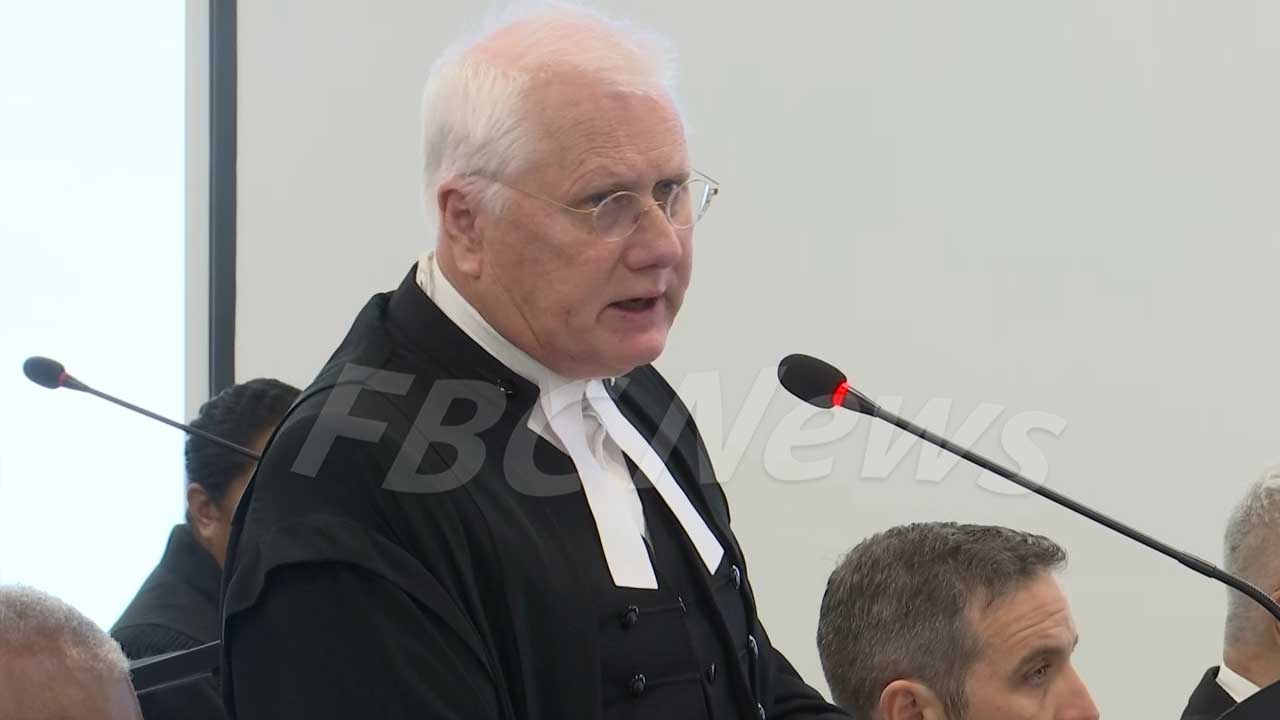
Australian barrister Bret Walker has told the Supreme Court of Fiji that the Constitution must reflect the will of the people, as he opened submissions on behalf of the State in a landmark constitutional reference case.
Walker, appearing as lead counsel in the case brought by Cabinet, outlined two core features of Fiji’s constitutional framework before the judges.
He said parliamentary democracy and the rule of law both must work in tandem to uphold the legitimacy of self-government.
“There are at least two fundamental features of the Fijian polity reflected in its Constitution,” he said.
“First, democracy through parliamentary government… and second, the rule of law, given effect by judicial enforcement.”
He emphasised that democracy, by definition, requires the ability of the people, through periodic elections and their elected representatives, to amend their own Constitution.
Denying that power, he said, would contradict not only democratic principles but also the dignity of the voters.
“It is a contradiction of democracy understood in that ordinary way to deny the voters the capacity to alter any existing provisions by the means constitutionally provided.”
Walker further submitted that Parliament, as the lawmaking body representing the people, has already demonstrated its role by trying to pass a Bill with had the support of 40 out of 55 Members of Parliament.
“Parliament is the organ under the Constitution for lawmaking on behalf of the people.”
“It is Parliament that can bring about the proper, non-contradictory position concerning the Constitution’s own amendment provisions.”
Walker has argued before the Supreme Court of Fiji that the 2013 Constitution’s so-called “double entrenchment” provisions may be incompatible with core democratic principles, describing them as unduly restrictive and lacking democratic legitimacy.
He was referring the provisions in the Constitution that warranted a two-third majority MP’s support changes to the constitution followed by a referendum.
“When I say prohibited, the Constitution says, and you can’t alter that prohibition,” he said.
He described this as a double entrenchment, a constitutional mechanism designed to make certain clauses unchangeable, or nearly so.
“These are obstacles designed in such a way that cannot live with the democratic nature of such a constitution,” he said.
“The experience in Fiji has always been two-thirds. Why three-quarters on this occasion?”
He argued that the increase in the amendment threshold to three-quarters of Parliament had no clear connection to other constitutional provisions and appeared arbitrary.
Walker also compared the 2013 Constitution’s final form with the more participatory process led by the Yash Ghai Constitutional Commission, which had recommended against a referendum and was ultimately sidelined.
“There hasn’t been a referendum in this country,” he said.
“And some might say parliaments cost a lot too, but to add a referendum to Parliament as a barrier to change is not something to be done lightly.”
Walker submitted that the three-quarters amendment requirement was viewed by many at the time of drafting as a deliberate obstacle to constitutional change.
“A three quarters referendum was just obviously intended as an obstacle. And so we submit.”
The hearing continues before the full bench of the Supreme Court, with interventions expected from political parties, civil society organisations, and legal institutions.
The hearing will continue for whole of the day.