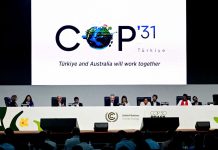

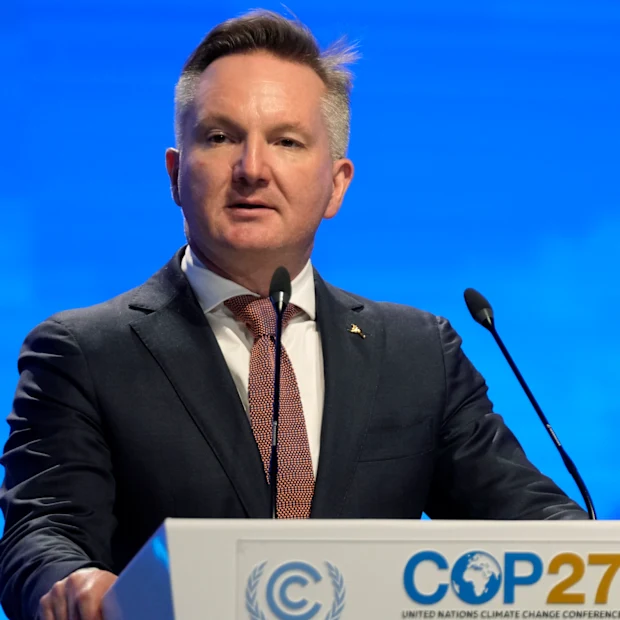
The Albanese government’s bid to host the huge COP31 global climate summit is more than three years old. Just over 12 months out from the event, it has yet to secure the meeting
By Ryan Cropp, Energy and climate reporter
The timing of United Nations climate chief Simon Stiell’s visit to Australia last week was not accidental. Climate is on the political agenda in 2025, both at home and abroad, and Stiell was here to send the government message – or two.
The first, regarding Labor’s looming decision on its 2035 emissions reduction target, due by November, was obvious: go big, bold and ambitious, he said.
“Bog standard is beneath you.”
But it was the second – on the ongoing impasse with Turkiye over Australia’s joint bid with Pacific Island nations to host a huge UN climate summit in Adelaide in 2026 – that appeared to be the main reason he travelled halfway around the world to give the government a sermon.
“It’s not dreaming – it’s dragging,” he said, fresh off the plane from a comparatively more low-key visit to Australia’s bid rivals in Ankara. “A decision needs to be made very quickly and the two proponents need to come together.
“Our position is please … resolve this quickly.”
He’s not the only one who is getting impatient. For climate advocates, clean energy businesses and environmentally threatened Pacific Island states that most stand to benefit from an Australian-held event, the government’s inability to end the impasse has become a source of immense frustration – and concern.
The summit, known as the 31st Conference of the Parties, is the UN’s annual talkfest on global emissions reduction, and doubles as a kind of giant trade fair for the green economy. Hosting it would probably see more than 20,000 world leaders, officials, businesses, boffins and hangers-on descend on Adelaide in November 2026.
Advocates say it would be a global showcase for Australia’s new green industries; a prompt for Labor to take more ambitious climate action; and a diplomatic boon for Australia in both Asia, the source of most trade opportunities, and the Pacific, where climate change is a top-ticket item.
But three years after Labor launched Australia’s bid to host COP31 – and just 15 months out from the event – it is yet to secure the meeting.
That’s a political problem for the government, which has staked its credibility on winning the bid and now has about three months left to lock it in before it reverts, by default, to Bonn in Germany.
It’s also a policy problem, according to Stiell, because aside from the practical difficulties of organising such a massive event at short notice, a short lead time also severely limits the substantive outcomes of the conference itself.
“The delay in making that decision is unhelpful to the process,” he said. “The logistical lift is a heavy one, but more important [is] the substance, in terms of joining up outcomes from preceding COPs with visions for future COPs.
“The lack of clarity creates tensions that are completely unnecessary at this stage.”
The delay, in short, risks turning the first-ever Pacific COP into a damp squib – with little to show for it bar a few rousing speeches and a lot of new frequent flyer miles.
The hold-up is not for want of trying on Climate Change and Energy Minister Chris Bowen’s part. Bowen has become something of a celebrity on the international climate circuit – the result of his robust advocacy as Australia’s top representative at the past three COP summits.
As The Australian Financial Review reported in May, Bowen is widely expected to become the next COP president – should Australia secure the bid – taking control of the complex, drawn-out and often painstaking negotiations that begin more than a year out from each summit.
His department, too, has led from the front on the COP bid, for which Australia is in the box seat – and has been for almost three years.
Standing in its way, though, has been Turkiye, a perennial thorn in the side of prospective COP hosts. A few years back, it played a similar game with the United Kingdom prior to the 2021 Glasgow summit, only withdrawing after a long and drawn-out negotiation.
COP hosts are decided on a consensus basis, meaning Australia requires the support of all 28 members of the Western European and Others Group in which it finds itself. By most accounts, Australia has the full backing of 23 of the 28 members, while no member has publicly backed Ankara’s bid.
Lacking any real support, Turkiye had been widely expected to withdraw after the Australian federal election. Indeed, Australia had been banking on it, having been given an indication that a deal was on the cards by a senior member of the Turkish delegation at the Copenhagen ministerial meeting on climate change less than a week after the election result in May.
Cue surprise, then, when at a subsequent pre-COP meeting in the Germany city of Bonn in June – which many had earmarked as a potential deadline to secure the bid – the Turks showed up and effectively launched their campaign, holding an official reception and announcing a host city, Antalya, which has previously played host to G20 and NATO conferences.
When asked for comment, a spokeswoman for Bowen pointed to a major speech delivered by the minister in June.
“It was legitimate for Turkiye to wait for the results of our election, given the opposition’s then position [opposing the bid],” he told an energy industry conference. “But given our election, and the strong support for our bid from our group, we are hopeful of a resolution before too long.”
The overarching mood in government is one of frustration with the process, and with Turkiye, which has been prone to giving mixed signals about its openness to a deal – as evidenced by the events in Bonn.
Lack of co-ordination
According to several climate policy, government and industry insiders who spoke to the Financial Review on condition of anonymity, what has been lacking on the Australian end until recent months has been a more fulsome, whole-of-government approach to securing the bid, involving not just Bowen’s department but the entire foreign affairs apparatus and the prime minister himself.
According to this point of view, until recently, those at the top of government – principally Prime Minister Anthony Albanese and Foreign Affairs Minister Penny Wong – have not prioritised the bid.
Instead, Australia’s efforts to bring the summit Down Under were for a long period considered a curious escapade of Bowen’s, and left to the less diplomatically astute Department of Climate Change and Energy.
Recent opportunities for Albanese and other top-level officials to get together with Turkish President Recep Tayyip Erdogan and their counterparts have been either missed or squandered.
According to a source with knowledge of the bid, June was “a month of missed opportunities”.
Alongside Bonn was the G7 in Canada, where the prime minister had a chance to put pressure on other world leaders Erdogan might listen to, and the NATO summit in The Hague, which could have facilitated a face-to-face meeting – had Albanese chosen to go.
Greens senator Sarah Hanson-Young has argued that the prime minister needs to engage constructively with Erdogan to get past the deadlock.
“Australia needs to talk turkey with Turkiye. It’s time for both the prime minister and foreign minister to flex some diplomatic muscle,” she said in July.
Turkiye’s renewed efforts to host the COP31 summit blindsided Australian officials.
Smart Energy Council chief executive John Grimes told the National Press Club in July that Labor needed to show the same urgency the government showed during Matthias Cormann’s bid to be OECD secretary-general, and earlier, when Paul Keating’s government secured the Sydney Olympics.
Some have tried to interpret the delay as a sign that Albanese has lost interest in COP – if he was ever interested in the first place – seeing in it many quite significant risks and only limited upside.
Despite the difficulties climate policy has created for the federal opposition, the issue is not necessarily a political advantage for Labor. Ongoing difficulties around the pace, cost and social effects of the clean energy rollout – particularly in regional areas – have become something of a political liability for the government.
The promise – and failure – to reform the country’s broken environmental laws during Labor’s first term of parliament was a function of these conflicting forces: the climate crisis on the one hand, and economic and political demands on the other.
The backlash to the federal government’s lackadaisical response to South Australia’s ongoing algal bloom disaster, too, has highlighted both the urgency and the risk of the summit.
Others have tried to put blame for failing to lock in COP31 at the feet of the Department of Foreign Affairs and Trade, which they accuse of lacking any real interest in the bid.
“Our bid has not been very well co-ordinated,” says one high-ranking government official.
“DFAT haven’t been fully engaged. I just don’t think we have been taking it as seriously as needed.”
An experienced climate diplomat said: “DFAT have been like a wet sock on COP. Unmotivated. Diplomatic capital was not spent and after three years we still don’t have the bid sorted.”
Emblematic of this alleged lack of urgency has been the management of the departure of climate change ambassador Kristin Tilley, Australia’s top climate diplomat, who left her post in June and has still not been replaced.
A spokeswoman for Penny Wong said the prime minister and foreign minister had led Australia’s efforts to secure the COP summit.
“Our commitment to winning the bid to host the very first Pacific COP has never been stronger,” the spokeswoman said.
“We will continue to work to elevate Pacific voices on the international stage and to drive global action on climate change.”
Complexities in the bidding process
The story, others insist, is more complex than a simple lack of will on Australia’s part.
Turkiye was not in the race when Australia launched its bid in 2022. Even after it joined, few expected its bid to go anywhere. And when there have been hosting disputes in recent years, countries have been prepared to do deals.
According to two sources with close knowledge of the bid, Australia and Turkiye had been close to a deal earlier this year. However, uncertainties around the election result, and Peter Dutton’s threats to cancel the event, raised the prospect that Turkiye might win hosting rights after an Australian withdrawal. That, though, would not explain why Turkiye has remained in the race following Labor’s landslide victory in May.
Post-election, the Coalition has declined to take a clear position on whether it supports the bid, although energy spokesman Dan Tehan expressed scepticism in an interview with Sky News on Sunday.
“We aren’t getting the outcomes that from these climate change conferences that people are proclaiming that we’re getting,” he said. “What’s the cost and what will be the outcomes? Sadly, after every climate change conference that the world has had, global emissions have continued to rise.”
Those close to the bid insist that the federal election marked a major turning point for the co-ordination of the government’s efforts.
During the campaign, Albanese showed up in Adelaide and declared it as the government’s preferred summit host, tying himself personally to the bid’s success. The prime minister has spoken with Erdogan, and on Friday raised the issue on a call with UN Secretary-General António Guterres.
Wong, too, met with her Turkish counterpart at the ASEAN summit in Malaysia on 12 July – with COP among the topics discussed. Both Wong and Bowen have visited the Pacific Islands since May 3, while DFAT officials travelled to Turkiye last month to try to find a solution.
A June cabinet meeting also included a substantial discussion of the bid, including how to co-ordinate it and frame it, as well as logistical considerations about hosting in November 2026.
Even if it wanted to, the government would also find it difficult to back out now. Withdrawal of the bid would be seen as a major diplomatic embarrassment, especially among the geopolitically sensitive Pacific Island nations the bid was partially designed to court.
Failure, too, would also be very poorly received in the Labor state of South Australia, which is banking on an economic bonanza akin to hosting a summer Olympics.
Former prime minister Malcolm Turnbull told the Financial Review that hosting COP was likely to put pressure on Australia to show more ambition on climate policy – and expose it to criticism for its failures.
“People will criticise us for still mining coal and gas and so forth. But on the other hand, things like Snowy 2.0, progress towards other pumped hydros, the gigantic rollout of solar – all of these things will be highlighted,” he said.
“[But] it’s a good opportunity to promote Australia and Australian action on climate – and if it puts pressure on us to do more, I’d welcome that.”
In September, the prime minister will meet with his Pacific counterparts at the Pacific Islands Forum, before heading off to New York for the UN General Assembly, which many view as the next key opportunity to secure the bid.
In the meantime, Australia has begun planning for success, hiring more than a hundred new COP-focused public servants inside the Department of Climate Change and Energy.