
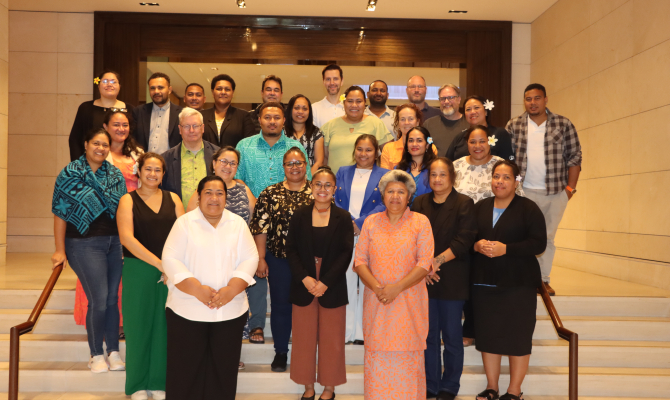
With plastic pollution at crisis levels, delegates from 14 Pacific Island countries have arrived in Geneva, Switzerland, with one clear message for the world: courage, not compromise.
Only a bold, comprehensive, and legally binding treaty that addresses the entire lifecycle of plastics—from production to disposal—can bring an end to the plastic pollution crisis.
As the intended final session of the Intergovernmental Negotiating Committee (INC-5.2) — tasked with crafting a global treaty to end plastic pollution, including in the marine environment — begins next week, delegates from Pacific Small Island Developing States (PSIDS) convened in Geneva on Friday, 01 August, for a preparatory meeting.
The session provided an opportunity for PSIDS to discuss priority issues, refine negotiating strategies, and build consensus on key positions, ensuring the region’s voice is present, informed, and impactful in every negotiation room.
“The stakes for the Pacific region are seriously high. For decades, the Pacific Ocean, central to the identity, economy, and survival of our island nations, has borne the brunt of global plastic pollution. From microplastics in fish to marine debris washing up on remote atolls, the impacts of a broken plastic system are felt daily,” said Pepetua Latasi, Chair of PSIDS and Tuvalu’s Permanent Secretary for the Ministry of Home Affairs, Climate Change and Environment.
“We’ve come to Geneva with a commitment to finalise and establish a legal instrument that meets the scale of the plastic pollution crisis. Our message to the world is simple: do not ask the Pacific to compromise on its future. We are calling for courage, ambition, and accountability,” Latasi stressed.
The Geneva session marks three years of intense negotiations following the landmark UN Environment Assembly (UNEA) Resolution 5/14, which in 2022 tasked countries with developing a comprehensive, legally binding instrument that addresses plastic pollution across its full lifecycle.
The previous round, INC-5 in Busan last November, originally intended to conclude the treaty, ended without consensus. Key issues remained unresolved, including whether the treaty should focus solely on plastic waste reduction or address the entire plastic lifecycle, and the level of financial support for implementation, particularly for SIDS.
“The Pacific has come to Geneva prepared and united,” said Anthony Talouli, Director of Waste Management and Pollution Control at the Secretariat of the Pacific Regional Environment Programme (SPREP). “We know the days ahead will be long, but we are ready.
“There is an overwhelming number of nations that want a legally binding treaty that limits plastic production. If we show political will and collective ambition, we can end plastic pollution in our lifetimes. That’s the future the Pacific believes in, and that’s the future we’re fighting for,” Anthony Talouli stressed.
Since 1950, an estimated 11 billion tonnes of virgin plastic have been produced globally—with annual production rising from just 2 million tonnes in 1950 to 504 million tonnes in 2022. If current trends continue, global plastic production is projected to triple by 2060.
The treaty under negotiation aims to address the entire lifecycle of plastic, from raw material extraction and production to end-of-life management. This holistic approach is vital for the Pacific, where plastic pollution poses an existential threat.
The second part of the fifth session of the Intergovernmental Negotiating Committee to develop an international legally binding instrument on plastic pollution, including in the marine environment (INC-5.2), will take place from 05 to 14 August 2025 at the Palais des Nations in Geneva, Switzerland.
The Pacific Islands are represented by the Cook Islands, Federated States of Micronesia, Fiji, Kiribati, Marshall Islands, Nauru, Niue, Palau, Papua New Guinea, Samoa, Solomon Islands, Tonga, Tuvalu and Vanuatu through the support of the Government of Australia and the United Nations.