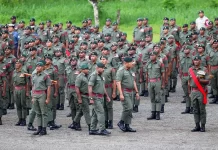

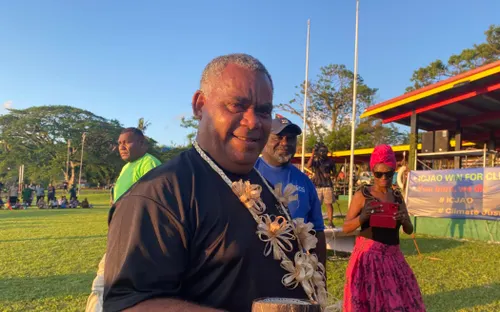
The 45th anniversary of Vanuatu’s independence was marked by a “Victory March”” through Port Vila, commemorating both the nation’s hard-won freedom and its recent breakthrough at the International Court of Justice (ICJ).
This year’s theme, Vanuatu We Stand, reflected the country’s enduring spirit of unity and resilience — sentiments amplified by the ICJ’s Advisory Opinion (AO) in favour of Vanuatu’s global campaign for climate justice.
Prime Minister Jotham Napat, addressing the crowd, reflected on the nation’s journey over the past 45 years.
“Forty-five years ago, our fathers walked this path and chose self-determination and sovereignty. We must now finish what they started,” he said. “We will no longer bow to the giants. We have the same rights as any other country.”
The PM commended youth groups, civil society organisations, and Pacific students whose efforts were key in bringing Vanuatu’s climate justice campaign to the world stage.
“This judgment is a landmark. It was initiated by students and supported by academics, civil society, and governments. It required political will — something we have shown, even as a small nation that some struggle to find on the map,” Napat said. “But when the ICJ handed down its opinion on 23 July, the world asked: ‘Where is Vanuatu?’ That alone shows how powerful our voice can be.”
He made clear that this legal outcome is not about asking for handouts from major polluters, but a matter of survival.
“We thank God Almighty that the big polluters have finally heard our call. We are not begging; we are demanding action — specifically, a reduction in emissions.”
Climate Change Minister Ralph Regenvanu linked the ICJ milestone to Vanuatu’s broader independence story.
“Our walk for climate justice began on July 30, 1980 — the day we became an independent nation and took back political power for our indigenous people,” he said.
Regenvanu reviewed Vanuatu’s international advocacy history, recalling milestones such as the founding of the Alliance of Small Island States (AOSIS) and joining the Non-Aligned Movement.
He acknowledged the leadership of figures like founding Prime Minister Father Walter Lini, former Deputy Prime Minister Sethy Regenvanu, and Vanuatu’s first United Nations Ambassador Robert Van Lierop.
“Our independence was not just a political step — it was a declaration of our right to determine our future,” Regenvanu said.
“But the impacts of global warming, caused largely by other nations, have placed that future in jeopardy. That’s why we must continue fighting for our rights and for climate justice.”
Minister of Internal Affairs Andrew Solomon Napuat also spoke at the event, reflecting on the strength of this year’s theme.
“Vanuatu We Stand is a call to rise — in unity, in resilience, and in shared responsibility,” he said. “This parade is more than a celebration — it’s a recognition of an historic achievement. The ICJ’s AO proves that even a small country like Vanuatu, with a population just over 300,000, can drive landmark global change.”
Minister Napuat also acknowledged Minister Regenvanu’s efforts and thanked international partners for their support throughout the campaign.
“This walk for climate justice shows that Vanuatu does not stand alone. The presence and solidarity of nations worldwide reflect the true meaning of independence,” he said.
As Vanuatu continues to push for global climate accountability, the 45th Independence Anniversary becomes not only a celebration of history but a declaration of its determination to shape the future.