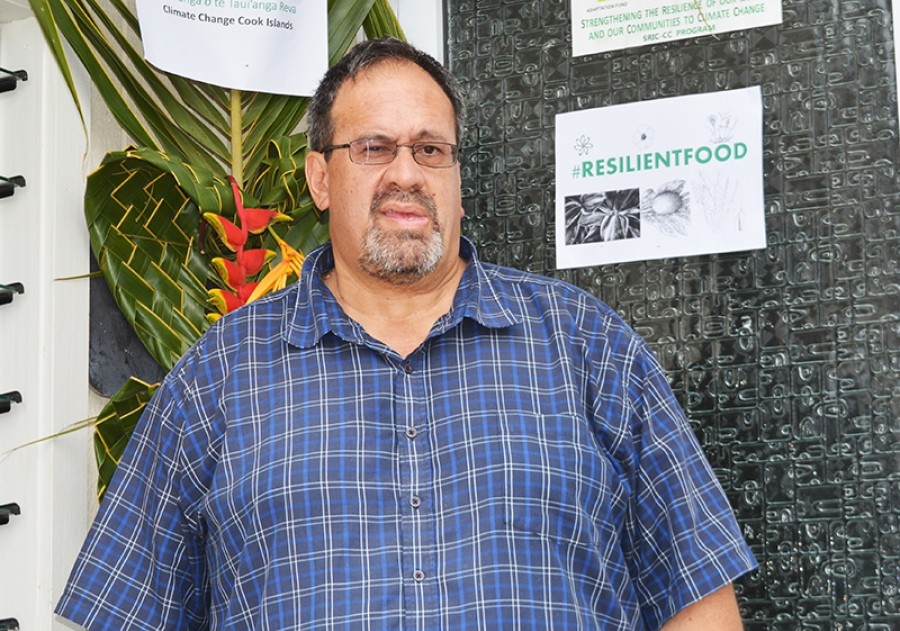
The recent International Court of Justice (ICJ) ruling on climate change could mean that the Cook Islands’ interactions with all states can be ‘prefaced by the ICJ,’ says Cook Islands Climate Change director Wayne King.
King made this comment in response to the recent landmark decision made by a top United Nations court allowing countries to sue other countries over climate change.
This was a non-binding ruling from the ICJ in The Hague, Netherlands, last Wednesday.
King says, “The landmark ruling by the ICJ means that those states responsible for high emissions are legally bound under international law to take action on climate change.
“The call by the international court was clear after many submissions and after a UN General Assembly resolution.”
He said all states must also report those actions to address climate change under the Paris Agreement through their national reporting called nationally determined contributions (NDC).
“For the Cook Islands, this could mean that our interactions with all states can be prefaced by the ICJ decision.
“Further, the door can be open to those states who do not take adequate action, to be legally challenged,” he added.
In its ruling, the ICJ said that developing nations have a right to seek damages for the impacts of climate change, such as destroyed buildings and infrastructure. It added that where it is not possible to restore a part of a country, its government may then seek compensation.
The court’s opinion was the culmination of six years of advocacy and diplomatic manoeuvering, which was started by 27 University of the South Pacific law students in Vanuatu in 2019. They were frustrated at what they saw as a lack of action to address the climate crisis and saw current mechanisms to address it as woefully inadequate, RNZ Pacific reported.
Their idea was backed by the government of Vanuatu, which convinced the UN General Assembly to seek the court’s advisory opinion on what countries’ obligations are under international law.
According to the RNZ Pacific, the court’s 15 judges were asked to provide an opinion on two questions: What are countries obliged to do under existing international law to protect the climate and environment, and, second, what are the legal consequences for governments when their acts – or lack of action – have significantly harmed the climate and environment?
It was earlier reported that in December last year, a Cook Islands delegation led by the Ministry of Foreign Affairs and Immigration (MFAI) director of the Treaties, Multilaterals and Oceans Division, Sandrina Thondoo, including Foreign Service officer Peka Fisher and external counsel, Auckland University senior lecturer Fuimaono Dylan Asafo, made submissions before the ICJ in The Hague.
MFAI has yet to comment on this landmark ruling.
Cook Islands National Council for Women president Vaine Wichman, who also made a submission to the ICJ in December last year, has already welcomed the decision, saying, “The critics of this unbinding legal agreement would say … oh well, it’s not binding. They miss the point. It is documented in the highest legal court of the world.”
“Women have a strong faith in believing that how you treat someone or something will reflect on you one day. Everyone knows the story of David and Goliath. Need I say more?”
She said, “The road to this decision from The Hague has been a lengthy one.”