


Kauaka Petaia guided his motorboat out of Tuvalu’s main lagoon at dawn and into the vast Pacific Ocean, where he and his nephew scanned the rolling horizon for signs of their country’s most precious resource: tuna.
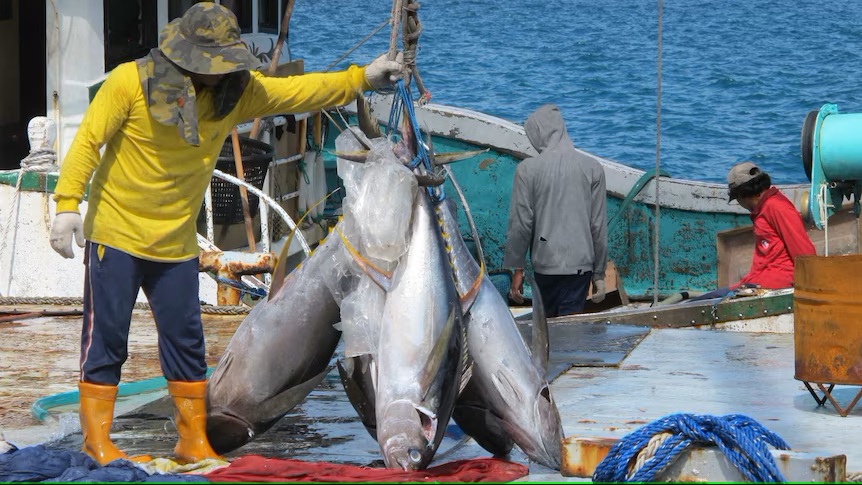
They searched for more than two hours before finally spotting seagulls circling in the distance. Petaia threw open the throttle as his nephew, Ranol Smoliner, tossed a hooked line into the water. Soon, the younger man felt the tug of a 25-pound yellowfin, which he pulled up and bashed with a club. By morning’s end, the pair had caught eight tuna – a haul far smaller than when Petaia’s father taught him to fish 30 years earlier.
“We have to spend longer and go farther to get them,” the 48-year-old said as the fishermen unloaded their catch.
“I’m not sure there will be any tuna left by the time I’m my uncle’s age,” added Smoliner, 22.
Tuna is a pillar of life in the Pacific, where for centuries people have braved the ocean to bring back yellowfin, skipjack, bigeye and albacore for their families.
In recent decades, as global demand for tuna has soared, Pacific island nations including Tuvalu have propped up their struggling economies by selling licenses to allow international fishing companies to trawl their vast exclusive economic zones. These seas provide as much as one-third of the world’s tuna supply.
But climate change is warming the world’s oceans at an accelerating rate, threatening livelihoods.
Scientists predict that climate change will push tuna away from Pacific island nations and toward the high seas, where wealthier countries with large fishing fleets – China, Japan, South Korea and the United States – will catch them without paying license fees.
It is yet another climate danger for a country – population 10,000 – whose existence is already threatened by rising seas, increasingly powerful storms and a potential exodus of people.
“It’s ironic that the ocean, which has been the sustainer of our livelihood and economy, suddenly poses all these threats to us,” Tuvalu’s prime minister, Feleti Teo, said in an interview here.
This low-lying atoll nation has become a premonition of climate change. Its leaders have delivered desperate pleas – including one delivered while thigh-deep in water – about the existential threat of rising sea levels.
The potential exodus of fish threatens to strip Tuvalu and other Pacific island nations of the very money they need to fight the impacts of global warming.
About 60 percent of Tuvalu’s locally generated government revenue comes from fees foreign countries pay to fish for tuna in its waters, Teo said. That revenue has plunged by about 40 percent over the past five or so years, denting the tiny nation’s overall budget by almost 6 percent.
Scientists say it’s hard to know how much of that recent drop is due to climate change as opposed to natural migration linked to ocean cycles.
But scientific modeling suggests Tuvalu could lose one-quarter of its tuna by 2050.
Efforts are underway to help Tuvalu and 13 of its neighbours track how tuna populations are shifting and to demand remuneration. They were recently awarded more than US$100 million from the Green Climate Fund (GCF) to help adapt.
“Pacific island countries are fighting hard to establish our rights to be compensated for fish that are caught in the high seas,” Teo said. “If we are able to definitively assert that the stock that used to occur in our EEZ is now in the high seas as a result of climate change, then that will strengthen our case.”
Warming waters are also bleaching local corals, depleting reef fish that Tuvaluans depend on for food. Some of the GCF grant will go toward fish aggregation devices: floating structures that help lure larger ocean fish, including tuna, closer to shore for locals to catch.
Coral bleaching also disrupts the natural wave protection of atolls like Tuvalu and the replenishment of their shores, said Arthur Webb, who led the Tuvalu Coastal Adaptation Project to reclaim swaths of desperately needed land in the capital.
Each day, a dredging machine in Funafuti’s lagoon sucks up sand and pumps it onto reclaimed areas. Sand is also pumped into large bags that are stacked to form protective seawalls. The new land is left to settle before building, which has yet to begin.
Tuvalu is roughly five feet above mean sea level. But its waters are now rising by about an inch every five years – well above the global average – and estimated to reach 2 to 3 feet by 2100, according to Moritz Wandres, an oceanographer with the Pacific Community.
By 2060, once-in-50-years floods are predicted to occur every five years, rendering Tuvalu uninhabitable without large-scale adaptation efforts, Wandres said. King tides already routinely inundate much of Funafuti, where motorbikes splash through the water seeping up through the sandy ground.
Tuvalu is preparing. It has amended its constitution to protect its statehood and maritime zones, even if it no longer has any land. And it announced a plan to clone itself in the metaverse, preserving its history and culture online.
Catastrophic flooding is becoming more commonplace on this low-lying atoll, and king tides already routinely inundate much of Funafuti. Building works can only hold off the seas for so long. (Carolyn Van Houten/The Washington Post)
In 2023, Australia provided a more tangible escape plan when it created special visas, at least in part, to help up to 280 Tuvaluans per year escape the wrath of climate change.
More than 80 percent of Tuvalu’s population – or 8,750 people – has applied for the visa, according to official Australian figures released last Wednesday.
The predicted decline in tuna will only hasten the outflux.
“This is our only resource,” said Laitailiu Seono, a Fisheries Department officer, as he carved up tuna to be dried and sold. “That’s why we really want to look after them. No fish, no job.”
Compounding Tuvalu’s anxieties, the Trump administration has dealt Pacific island nations another blow, suspending US$60 million per year in South Pacific Tuna Treaty funds for the region – part of a long-standing deal to guarantee U.S fishing access.
During his presidency, Joe Biden promised to double the tuna treaty funds in a bid to counteract China’s efforts to woo Pacific island countries. Instead, Teo said, Tuvalu had yet to receive roughly US$7 million it had been counting on: “A big hole in our projected revenue.”
At the same time, President Donald Trump’s decision to open up the 400,000-square-mile Pacific Remote Islands Marine National Monument to commercial fishing suggested he could scrap the treaty altogether.
Like other Trump administration moves – pulling out of the Paris climate agreement, cutting U.S Agency for International Development funding and climate financing, and potentially putting travel restrictions on some Pacific countries, including Tuvalu – abandoning the treaty would hurt the United States’ strategic interests and boost that of its stated rival, China, said Alan Tidwell, director of the Centre for Australian, New Zealand and Pacific Studies at Georgetown University.
“If the U.S pulls out totally from the Pacific then someone has to fill that role,” agreed Teo, whose nation is one of only three in the region that still recognise Taiwan instead of China. “And we know who is eager.”
A State Department spokesperson said in an emailed statement that the department “will continue … to align its activities and programs with the foreign policy priorities of the President and the Secretary.”
When Kauaka Petaia returned to shore, his son Siuele was there to help him unload the tuna. The 27-year-old said he had no desire to follow in his father’s footsteps. Instead, he would soon head to Australia to work in a meatpacking plant, where the pay is more certain.
“By 2030 or 2050,” he said, “I don’t know if tuna fishing will still be a job in Tuvalu,” said Petaia.