
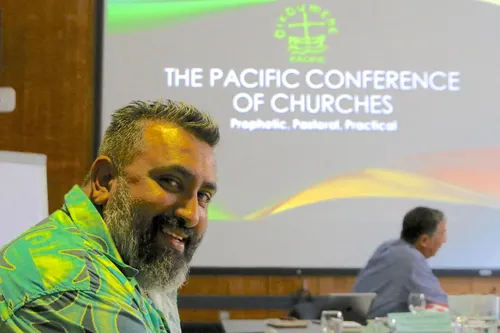
The Pacific Conference of Churches (PCC) has welcomed the International Court of Justice’s (ICJ) landmark climate ruling, describing it as a “watershed for climate justice” and backing a regional ban on deep-sea mining while urging the recognition of rights for nature.
Reverend James Bhagwan, General Secretary of the PCC, praised Pacific youth for driving the campaign that led to the advisory opinion.
“We begin by saluting the Pacific Island Students Fighting Climate Change. Your six‑year journey from a classroom idea to the Peace Palace has changed the course of international law,” Bhagwan said.
“The PCC is privileged to have walked a small part of that voyage with you, and we are extraordinarily proud of what you have achieved for the whole creation.”
He also commended regional leaders for standing together on the global stage.
“We also honour Vanuatu and the wider Blue Pacific Continent for carrying this petition to the United Nations. Today’s unanimous Advisory Opinion proves that when the Pacific speaks with one voice, the world listens.”
The ICJ ruled that climate inaction could amount to an internationally wrongful act, potentially exposing states to reparations claims. The Court also affirmed that access to a clean, healthy, and sustainable environment is a human right.
“The World Council of Churches welcomes this moment as the day moral duty became legal obligation,” Bhagwan said. “It launches a Decade for Climate Justice Action urging governments to re‑orient policy towards ecological transformation.”
Bhagwan said the ruling reinforces the duty of all states to prevent transboundary harm, and warned that deep-sea mining is a direct threat to ocean health.
“Deep‑sea mining—whether driven by profit or marketed as ‘critical minerals’ for defence—would irreparably scar the blue heart of our planet. We therefore renew our call, echoed at last month’s UN Ocean Conference, for an immediate moratorium on all seabed‑mining activity.”
The PCC also pushed for a legal shift in how ecosystems are treated under the law, citing progress already made in Aotearoa-New Zealand and the wider Pacific.
“If a healthy environment is a human right, then rivers, forests, mountains, and the ocean must be recognised as rights‑bearing entities,” Bhagwan said.
“In 2024, Māori, Tahitian, Tongan, and Cook Islands leaders signed HeWhakaputanga Moana, a treaty granting whales legal personhood, so their suffering can be challenged in court.”
These developments show how “the Court’s language can be translated into statute,” Bhagwan added. “Pollution or ecological damage by any actor must trigger prosecution and full restoration.”
The PCC said it would continue to advance its agenda under the Tuākoi ‘Lei Declaration, including promoting development based on ecological well-being and Indigenous wisdom, pushing for a fossil fuel non-proliferation zone, and securing strong youth leadership in church governance.
“The Court has spoken; now the family of nations must act. Let us heed the Tuākoi ‘Lei summons to good‑neighbourly love by protecting creation, repairing injustice, and embracing a just transition worthy of our children,” Bhagwan said.
“The Pacific drum has sounded—may its rhythm guide the world towards an Ocean of Peace where peoples and planet flourish together,” he said.