

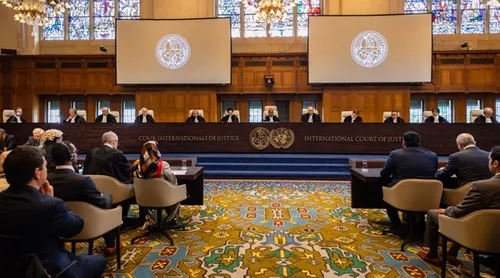
The historic climate change ruling at the International Court of Justice (ICJ) today is a landmark win for child campaigners, acknowledging the adverse impacts of climate change on child rights, and offering children renewed hope, Save the Children said.
The Advisory Opinion delivered by the world’s highest court finds that states’ legal obligations to address climate change extend beyond existing climate agreements. It also found that “states must take their obligations under international human rights law into account when implementing their obligations under the climate change treaties and other relevant environmental treaties.”
While not legally binding, leading environmental lawyers say the ruling “could become a guiding star for climate policies at all levels of governance”, including how States are held accountable under multiple areas of international law.
The Advisory Opinion originated from an extensive campaign led by a group of law students from the Pacific Islands, with strong support from Vanuatu .
In December last year, Vepaiamele, 16, a child campaigner with Save the Children Vanuatu, travelled to The Hague with the Government of Vanuatu – the only child to attend as part of a government delegation – to speak about the impacts of climate change on the Pacific island nation and call for action.
Vepaiamele said today: “This Advisory Opinion is everything I hoped for and I am so happy with this outcome as I know it will pave the way for a safer future for youth like myself and future generations, too.”
Speaking from The Hague last year, Vepaiamele said:“As a young Ni-Vanuatu girl, I feel the effects of climate change every day of every year. I’ve experienced many cyclones. It can be kind of terrifying sometimes, especially the really strong ones. Every cyclone, our classrooms are destroyed, our homes are flattened to the ground, and hospitals and communication towers are ripped apart. And then there’s also the mental health impacts, and we don’t really talk about it that much, but it can really cause anxiety in children and young people.”
Human-induced climate change is driving up global temperatures, with the past 10 years the warmest on record, according to the World Meteorological Organisation. Children, particularly those affected by inequality and discrimination, bear the brunt of climate change impacts that are already forcing them from their homes, putting food out of reach, damaging schools and increasing risks like child marriage as they are forced out of education and into poverty.
Limiting warming temperatures through the rapid phase-out of the use and subsidy of fossil fuels is critical for children’s rights and lives, Save the Children said.
Earlier this year, research released by the child rights organisation with the Vrije Universiteit Brussel (VUB) found that the difference between global temperature rise of 1.5°C and 2.7°C could see 38 million more children from the 2020 birth cohort face unprecedented lifetime exposure to extreme heatwaves.
Save the Children also called for increased climate finance targeted at helping children and their families, child-centred and locally led adaptation and an increase in the participation of children in shaping climate action.
Jack Wakefield, Save the Children’s Global Policy and Advocacy Lead on Climate Change, said:“For years, children and young people have watched their communities suffer the devastating impacts of climate change and have been calling for urgent, concrete action. Children we work with have told us how deadly heatwaves have closed their schools and disrupted their learning, how cyclones have destroyed their homes, and how crop failures have left them facing life-threatening hunger.
“This Advisory Opinion confirms what children have long known: current climate agreements are not enough. Climate inaction is a form of intergenerational injustice, disproportionately borne by those least responsible and least equipped to adapt. As the climate crisis intensifies and pushes children’s rights further out of reach, we hope this ruling will compel governments and the private sector to act with urgency and ambition.”
As the world’s leading independent child rights organisation, Save the Children works in about 110 countries, tackling climate change across everything we do. Save the Children supports children and their communities globally in preventing, preparing for, adapting to, and recovering from both sudden climate disasters and slow onset climate change.
“We have set up floating schools, rebuilt destroyed homes and provided cash grants to families hit by disasters.
“We also work to influence governments and other key stakeholders on climate policies, including at the UNFCCC COP summits, giving children a platform for their voices to be heard,” Save the Children said.