

“The Ocean of Peace is a signal that we seek a region in which strategic competition is managed; where stability is the touchstone of regional relationships; and where coercion is eschewed. The Ocean of Peace reflects my belief that a united region is a strong region: that when we speak with one voice, our power is magnified.”
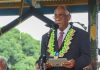
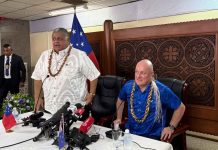
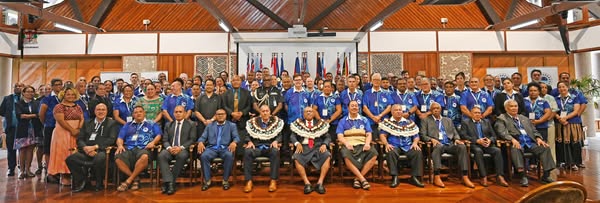
This was highlighted by the Prime Minister Sitiveni Rabuka while speaking at the opening of the Pacific Regional and National Security Conference held at the Pacific Islands Forum Secretariat in Suva Monday.
“The Ocean of Peace also calls for us to remain committed to development, because lasting peace across our countries requires both national security and national development.”
Addressing Pacific and regional leaders present at the conference, Prime Minister Rabuka emphasised that is Peace is not something achieved through our police or security forces alone.
“It also requires families and communities, societies and nations that are built on the foundations of harmony, stability, satisfaction with life and freedom from want and fear.”
He added that to achieve this, the Ocean of Peace concept draws on foundational tenets of Pacific regionalism.
“It is our opportunity to weave the threads of our Pacific past with our vision for our Pacific future.”
Prime Minister Sitiveni Rabuka further highlighted the momentum building across the region ahead of the upcoming Pacific Islands Forum Leaders Meeting in Solomon Islands this September.
“As we speak, officials across the Pacific are working to prepare the Ocean of Peace Declaration for when Prime Minister Tagelagi and I meet with our fellow leaders at the Pacific Islands Forum Leaders Meeting in Solomon Islands in September.”
While much work is ongoing, Prime Minister Rabuka added that Fiji promotes the Pacific as the Ocean of Peace based on the following twelve principles:
1.A shared commitment to the peaceful resolution of disputes based on the Pacific Way.
2.Respect for international law and norms. We recall the United Nations’ General Assembly Declaration on the Rights of People to Peace that was adopted on 12 November 1984
3.Rejection of coercion as a means to achieve security, economic or political advantage
4. The freedom to determine our own security and strategic policies
5.Upholding freedom of navigation and overflight.
6.A commitment to the non-proliferation of nuclear weapons.
7.Protecting the maritime environment.
8.A recognition that common challenges require common solutions.
9.Respect for human rights.
10.Support for regional institutions.
11.Calling on external actors to champion rules of responsible, peaceful, deconflicting behaviour.
12. Bringing our people together.
Pacific Islands Forum Secretary General, Baron Waqa, echoed similar sentiments calling for action that “protects lives, upholds peace, strength and trust within our communities.
The Pacific Regional and National Security Conference brings together security leaders, experts, and stakeholders to address the region’s pressing security challenges.
The forum also aims to map out current and emerging threats and support the implementation of the 2050 Strategy for the Blue Pacific Continent..